


When operating temperatures rise and corrosion accelerates, standard titanium grades reach their limits. A near-alpha heat-resistant titanium alloy - similar to the international Ti-6Al-2Sn-4Zr-2Mo (Ti-6242) family - delivers the elevated-temperature strength, stability, and reliability that aerospace and industrial applications demand.
Standard titanium alloys like Grade 5 (Ti-6Al-4V) excel at ambient and moderate temperatures. But at sustained service temperatures above 300–400°C, their strength and creep resistance decline.
Heat-resistant near-alpha titanium alloys solve this by combining aluminum, molybdenum, zirconium, and silicon in precise proportions - creating a microstructure that maintains mechanical integrity at elevated temperatures while preserving titanium's core advantages of low density and corrosion resistance.
| Property | Value | Advantage |
|---|---|---|
| Density | ~4.5 g/cm³ | 60% of steel - dramatic weight reduction in rotating and structural components |
| Tensile strength | 1,000+ MPa | High load-bearing capacity at elevated temperatures |
| High-temperature performance | Stable to 500°C+ continuous | Suitable for engine hot-section and heat-critical applications |
| Creep resistance | Excellent | Maintains dimensional stability under sustained high-temperature loading |
| Corrosion resistance | Outstanding | Resists oxidation, acids, alkalis, and aggressive process media |
| Thermal stability | High | No phase transformation or degradation under thermal cycling |
The result: a material that is lighter than steel, stronger than aluminum, more heat-resistant than standard titanium, and more corrosion-proof than nickel-based alternatives in many environments.


Why It Is Difficult to Machine
The very properties that make this alloy valuable also make it challenging to produce:
| Challenge | Cause | Consequence |
|---|---|---|
| High cutting resistance | Low thermal conductivity - heat concentrates at the cutting zone | Extreme tool wear, surface quality issues |
| Work hardening and adhesion | High toughness and ductility at cutting temperature | Material adheres to tool edges ("built-up edge"), dimensional accuracy difficult to maintain |
| Complex production chain | Melting → forging → rolling → heat treatment → finishing | Requires precise temperature control and process parameter management at every stage |
| High equipment requirements | Specialized metallurgy and precision machining capability | Higher production cost, limited manufacturing capacity |
These factors explain why this alloy has historically been confined to the most demanding applications - and why its cost remains above standard titanium grades.

Where It Is Used
Original applications: aerospace and defense
| Application | Component | Why This Alloy |
|---|---|---|
| Aircraft engines | Compressor discs and blades | Maintains strength at elevated temperatures during sustained operation |
| Rocket and missile structures | Flight structural components | Lightweight + high strength under extreme thermal loading |
| Military equipment | High-load, precision structural parts | Reliability under the most demanding service conditions |
Expanding applications: general industry
As production technology matures and costs decline, the alloy is migrating into broader markets:
| Industry | Application | Why |
|---|---|---|
| Industrial equipment | High-temperature structural components | Creep resistance, long service life |
| Precision machinery | High-load, precision-fit parts | Dimensional stability under thermal cycling |
| Specialty construction | Structural elements in corrosive environments | Corrosion resistance + strength |
| High-end consumer equipment | Premium structural components | Weight reduction + durability |
The Material Behind the Alloy
Heat-resistant titanium alloy bar begins as carefully processed raw material - titanium sponge melted with precise alloy additions (aluminum, molybdenum, zirconium, silicon) under vacuum or inert atmosphere. The ingot is forged, rolled, heat-treated, and finished to specification.
Every step in this process demands exacting control:
| Step | Critical Parameter |
|---|---|
| Vacuum arc remelting (VAR) | Chemistry homogeneity, freedom from inclusions |
| Forging | Temperature window, deformation rate, grain structure control |
| Rolling | Dimensional accuracy, microstructure uniformity |
| Heat treatment | Phase balance optimization - strength vs. ductility |
| Finishing | Surface quality, dimensional tolerance, straightness |
The performance of the finished bar - whether machined into a compressor disc, a drilling tool, or a precision fitting - depends on the quality of every step in this chain.
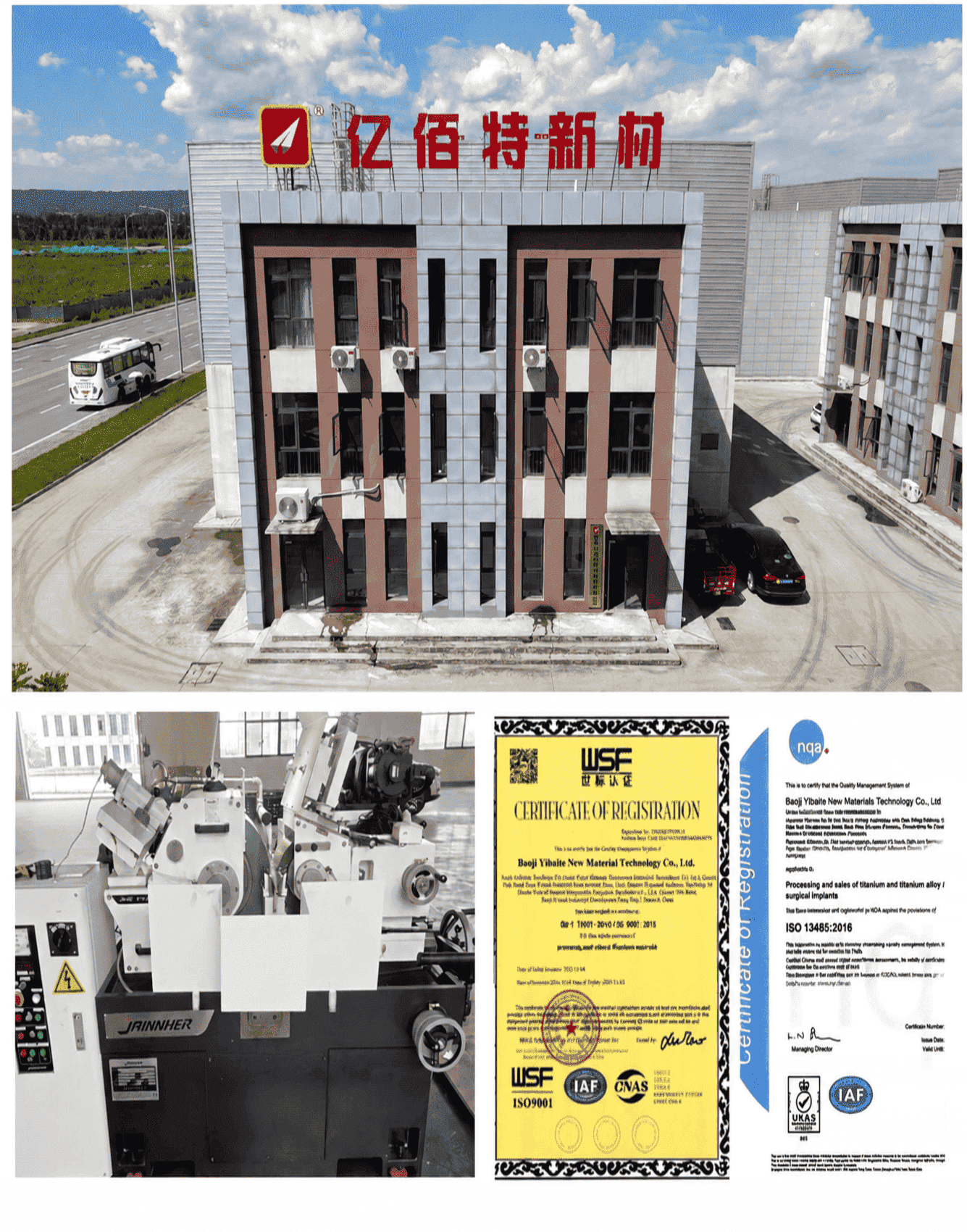
Baoji Yibaite New Materials Technology Co., Ltd. is a high-tech titanium processing company in Baoji, Shaanxi Province - China's Titanium Valley. We supply titanium bar and raw materials for high-performance structural applications - including heat-resistant grades for elevated-temperature service.
Our titanium bar capabilities:
| Parameter | Range |
|---|---|
| Diameter | Standard and custom series - from precision bar to large-format billet |
| Length | Cut to specification |
| Surface condition | Black surface, turned, ground, or polished |
| Material condition | Annealed, solution treated, or as-rolled |
| Quality verification | Full mill test certificates - chemistry, mechanical properties, microstructure |
Grades available:
| Grade | Designation | Application |
|---|---|---|
| Grade 2 | UNS R50400 | General structural and corrosion-resistant applications |
| Grade 5 | Ti-6Al-4V, UNS R56400 | The global standard for high-strength structural titanium - aerospace, industrial, medical. 900+ MPa tensile strength |
| Grade 23 | Ti-6Al-4V ELI, UNS R56401 | Medical and critical structural - maximum toughness |
| Heat-resistant near-alpha alloys | Ti-6Al-2Sn-4Zr-2Mo equivalent | Elevated-temperature applications - engine components, high-heat structural parts |
| Custom | Upon request | Application-specific compositions and specifications |
All products ship with full mill test certificates - chemistry, mechanical properties, dimensions - traceable from ingot to delivered product.
Whether you are an aerospace manufacturer sourcing bar for engine components, a drilling tool producer requiring high-strength titanium bar stock, an industrial equipment builder evaluating heat-resistant titanium, or a distributor serving the high-performance materials market - we are ready to discuss your requirements.
 1
1
The Takeaway
Heat-resistant titanium alloy bar represents the upper tier of titanium's performance spectrum - delivering elevated-temperature strength, dimensional stability, and corrosion resistance that standard grades cannot match at extreme service conditions.
Its value is highest in applications where failure is not an option: aircraft engine compressors, deep-well drilling tools, nuclear and energy equipment, and precision industrial structures. Its cost reflects the demanding production process - but its performance justifies the investment in every critical application.
From raw material melting to finished bar stock, quality control at every stage determines whether the alloy delivers its full potential. That control begins at the source - in China's Titanium Valley.