


INTRO
Titanium, known as the "space metal" and "ocean metal", is lightweight, strong, and corrosion-resistant. It is a key material in the aerospace, medical, and chemical industries. But you know what? Titanium is abundant in the Earth's crust (ranked 10th), but due to its highly reactive chemical properties and easy oxidation at high temperatures, extraction is extremely difficult. The Kroll method is the mainstream industrial production method, which requires "five passes and six cuts" throughout the entire process, with complex steps and high energy consumption. Below is the complete manufacturing process of titanium, from ore to finished product
1.Mineral processing
The "raw" titanium extracted from rocks does not exist in pure metallic form, but is mainly stored in ilmenite (FeTiO₃) and rutile (TiO₂), with rutile having a higher content of titanium and being a high-quality raw material. First, crush and grind the ore into fine powder; Then use magnetic separation, reselection and other methods to separate concentrates with high titanium content (ilmenite concentrate or rutile concentrate), and remove impurities such as iron and silicon.

2.Chlorination
The core step of converting titanium into a "liquid intermediate" (titanium tetrachloride) is to transform solid titanium oxide into liquid titanium tetrachloride (TiCl ₄) - a colorless, volatile, and highly corrosive liquid that facilitates subsequent purification and reduction. Mix titanium concentrate (TiO ₂) with coke (carbon) and place it in a chlorination furnace; Heat to around 1000 ℃ and introduce chlorine gas (Cl ₂) at the same time; Under high temperature, the reaction generates titanium tetrachloride vapor, which is cooled to obtain liquid crude titanium tetrachloride mixed with impurities such as ferric chloride.

3.Purification
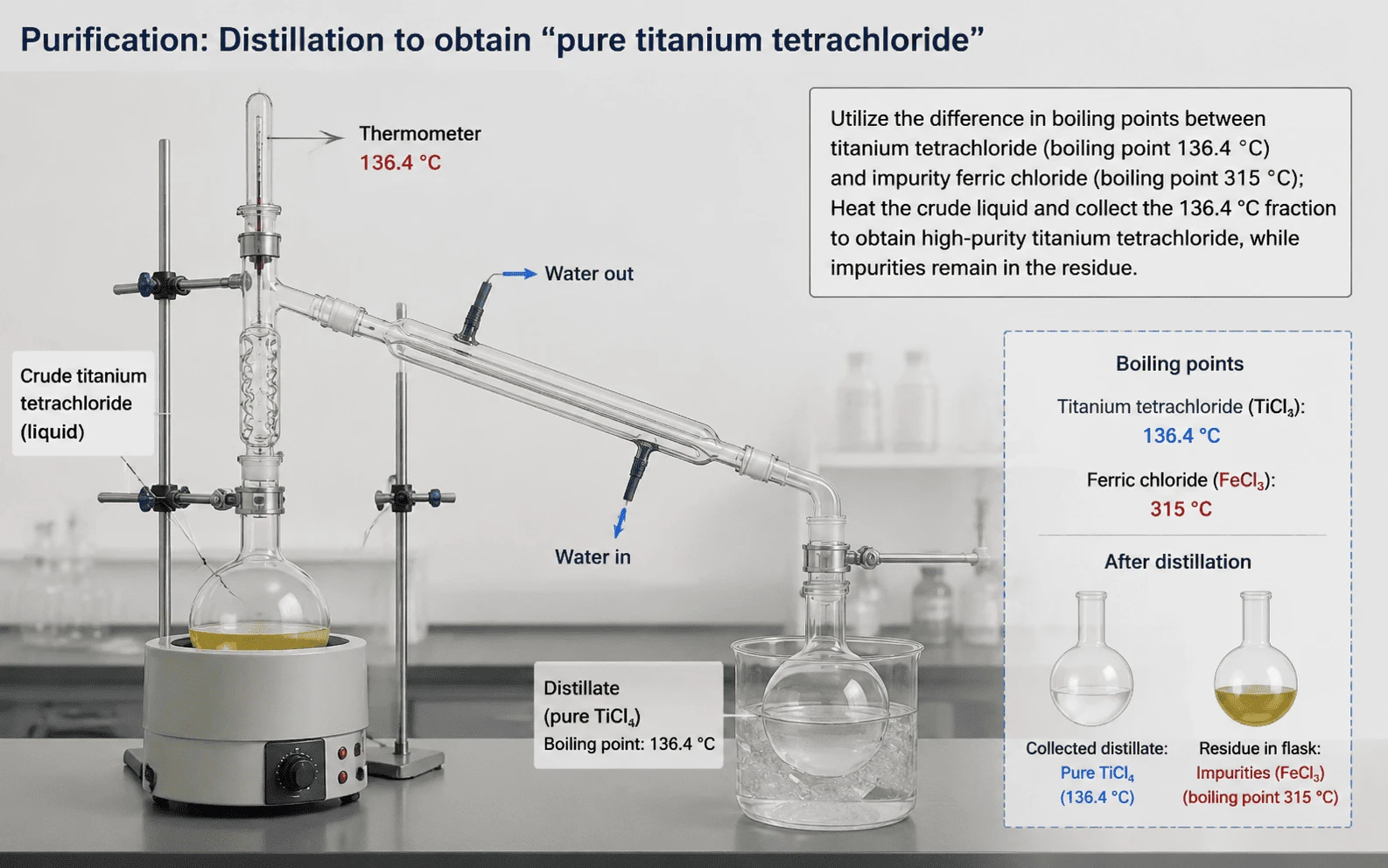
Crude titanium tetrachloride requires purification via distillation. This method relies on boiling point differences. TiCl₄ boils at 136.4°C, while iron chloride boils at 315°C. The crude liquid is heated. The fraction boiling at 136.4°C is collected as high-purity TiCl₄. Heavier impurities remain as residue.
4.Reduction
Magnesium "competes" for chlorine, giving birth to sponge titanium (core step). This is the most critical step in the production of titanium and also the core of the Kroll process - reducing titanium tetrachloride with metallic magnesium to obtain pure titanium. Pump pure titanium tetrachloride into a closed stainless steel reaction vessel, fill the vessel with argon gas (inert gas), and isolate the air (to prevent oxidation of titanium and magnesium); Place a magnesium ingot and heat it to 800-850 ℃ to melt the magnesium into a liquid state; Magnesium reacts violently with titanium tetrachloride to displace pure titanium; After the reaction is complete, the product is cooled to obtain porous sponge like titanium (commonly known as "sponge titanium") mixed with magnesium chloride and unreacted magnesium

5.Separation: Vacuum distillation, purification of sponge titanium
Magnesium chloride and magnesium impurities in sponge titanium must be removed, otherwise it will affect subsequent processing:
- Put the sponge titanium mixture into a vacuum distillation furnace and heat it to high temperature;
- In a vacuum environment, magnesium and magnesium chloride will vaporize and be condensed for recycling (magnesium can be recycled);
- The final result is sponge titanium with a purity of over 99.7%, presenting a gray black and porous structure.

6.Melting
From sponge titanium to titanium ingots. Sponge titanium is porous and loose, and cannot be directly processed into parts. It must be melted into dense titanium ingots. Sponge titanium is pressed into electrodes and placed in a vacuum arc melting furnace (or electron beam melting furnace); Electricity is applied in a vacuum environment, and the arc generates high temperatures (exceeding 1668 ℃, the melting point of titanium), causing sponge titanium to melt into liquid titanium; After cooling, liquid titanium is cast into titanium ingots - this is the basic raw material that can be used for forging, rolling, and processing.

7.Processing
Titanium ingots can be transformed into various products. Titanium ingots need to undergo subsequent processing before they can be transformed into the titanium materials we see.
- Forging/rolling: Heating titanium ingots and forging them into rods, plates, or rolled into pipes and foils using a press;
- Alloying: Adding elements such as aluminum and vanadium to make titanium alloys (such as TC4) to enhance strength and high temperature resistance;
- Surface treatment: polishing, anodizing, etc. to enhance corrosion resistance and aesthetics.

Why is titanium so expensive?
After reading the process, you will understand: high temperature throughout the entire process, vacuum/inert gas protection, multi-step intermittent reaction, extremely high energy consumption, and high technical threshold and cost of core equipment (such as vacuum furnaces and reaction vessels). In addition, titanium has strong chemical activity and is prone to oxidation and scrap during processing, further increasing costs.
Conclusion
To summarize the manufacturing of titanium, it is essentially a difficult transformation from oxide to chloride, and then to pure metal: ilmenite/rutile → chloride (titanium tetrachloride) → distillation purification → magnesium reduction (sponge titanium) → vacuum distillation → melting (titanium ingot) → processing and shaping. This process (Kroll method) has been used for over 80 years and is still the mainstream in industry. It is precisely because of this that titanium has become a "rare metal" that combines high performance and high value.