Titanium welded tubes are replacing stainless steel, copper-nickel, and even nickel alloy tubes across aerospace, energy, marine, and medical industries. Here is why - and what makes them so difficult to produce.
Why Titanium Welded Tubes?
1. High Strength-to-Weight Ratio
Tensile strength of 400–900 MPa (depending on grade) at just 4.51 g/cm³ density - roughly 57% of steel. Thinner walls handle the same pressure, saving weight across the entire piping system.
2. Half the Weight of Steel
Titanium welded tubes weigh 50% or less than equivalent stainless steel tubes - reducing support structure loads on offshore platforms, mobile equipment, and aircraft.
3. Self-Healing Corrosion Resistance
Titanium spontaneously forms a dense TiO₂ oxide film that resists seawater, wet chlorine, nitric acid, and hypochlorites. If scratched, it reforms instantly. Performance far exceeds stainless steel and copper alloys in aggressive media.
4. High-Temperature Capability
Conventional titanium alloys serve long-term at 350–400°C. Newer high-temperature grades (e.g., Ti-600) maintain strength and creep resistance at 600°C - suitable for furnace tubes, petrochemical heaters, and gas turbine exhaust.
5. Cryogenic Toughness
Grades like TA7 (Ti-5Al-2.5Sn) and TC4 (Ti-6Al-4V) retain ductility and impact resistance down to -196°C to -253°C - no brittle fracture, unlike steel. Ideal for LNG transfer and liquid oxygen/hydrogen systems.
6. Dimensional Stability
Thermal expansion coefficient of ~8.6×10⁻⁶/°C - about 60% of stainless steel, 40% of aluminum. Less thermal distortion, fewer joint leaks, reduced support fatigue under temperature cycling.
7. Biocompatibility
Non-toxic, non-allergenic, compatible with human tissue. Titanium welded tubes are used in medical implants, surgical instruments, and food/pharmaceutical-grade clean piping.
8. Lower Lifetime Cost
Higher upfront cost, but dramatically reduced maintenance, longer replacement cycles, and fewer unplanned shutdowns. Total cost of ownership often undercuts traditional materials over the system's life.
Titanium's performance advantages come with a significant manufacturing challenge: it is extremely reactive at welding temperatures, readily absorbing hydrogen, oxygen, nitrogen, and carbon - forming brittle phases that destroy joint properties.
Key welding requirements:
| Requirement | Detail |
|---|---|
| Pre-weld cleaning | Remove all oil, oxide, moisture, and dust. Grind + wipe with acetone. Weld within 2 hours. No bare-hand contact. |
| Triple argon shielding | TIG welding with high-purity argon (≥99.99%) covering the weld front, back, and trailing shield - until temperature drops below 300°C |
| Low heat input | Small arc energy, fast travel speed. Interpass temperature ≤100°C to prevent grain coarsening |
| Hydrogen control | Environment humidity ≤60% RH. Argon dew point below -40°C. Prevents TiH₂ formation and delayed cracking |
| Post-weld treatment | Vacuum stress-relief annealing when required. Inspection by visual (color check), radiography (RT), dye penetrant (PT), and hydrostatic/pneumatic testing |

Where Titanium Welded Tubes Are Used

Where Titanium Welded Tubes Are Used
| Industry | Application |
|---|---|
| Aerospace | Hydraulic lines, fuel lines, environmental control systems |
| Petrochemical | Heat exchanger tube bundles, acetic acid/chlor-alkali process piping |
| Marine/offshore | Seawater cooling, fire suppression, platform structural tubes |
| Cryogenic | LNG transfer, LOX/LH₂ lines |
| Medical | Clean process tubing, implant-grade components |
| Power generation | Condenser tubes, cooling water systems |
We Supply Titanium Strip and Plate for Welded Tube Production
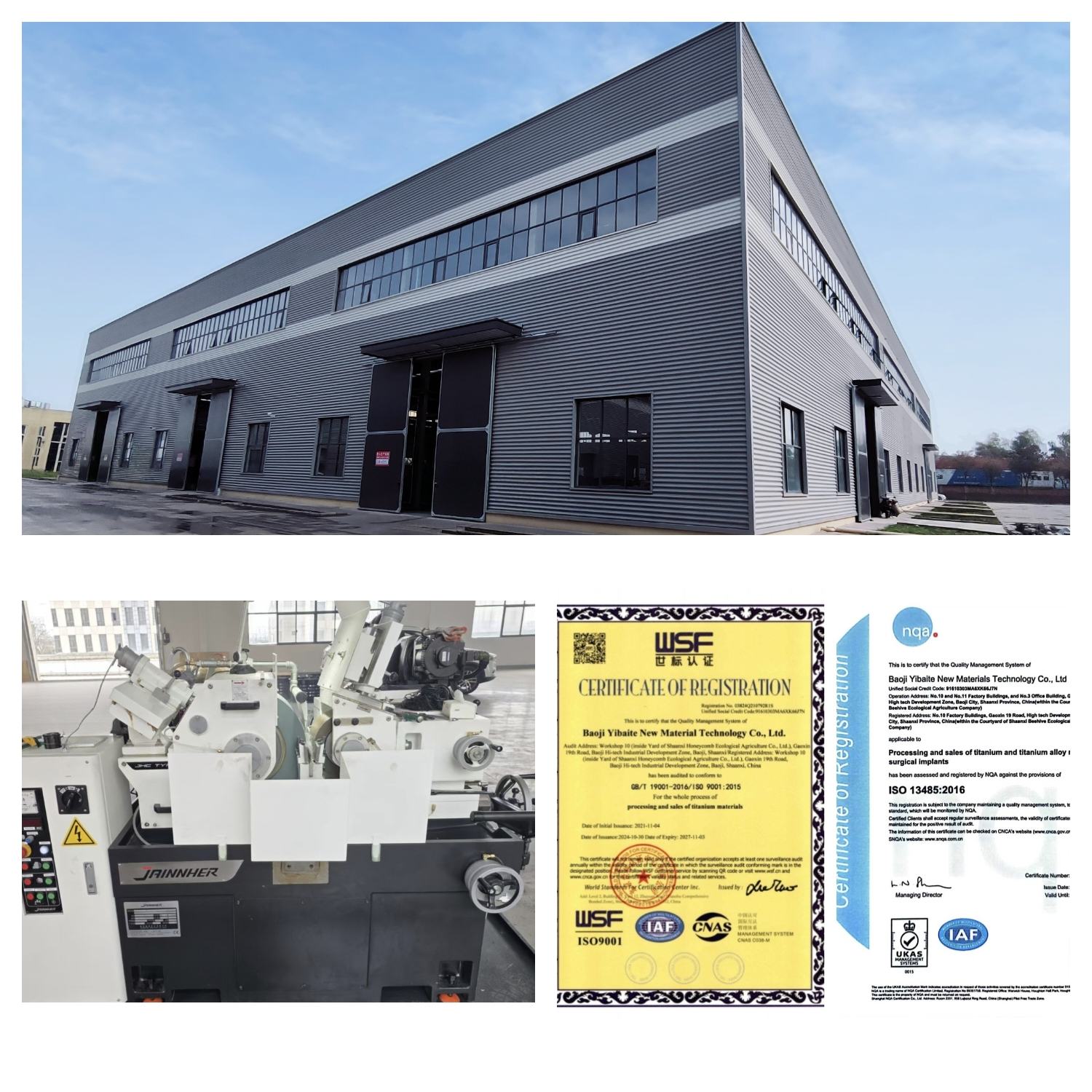
Baoji Yibaite New Materials Technology Co., Ltd. is a high-tech titanium processing company in Baoji, Shaanxi Province - China's Titanium Valley.
Titanium welded tubes are produced from titanium strip or plate - and that is where our role begins. We supply the upstream raw materials that tube manufacturers depend on:
- Titanium plates and sheets - for strip rolling and tube forming
- Titanium strips - precision-rolled for welded tube production
- Titanium bars and rods - for fittings, flanges, and machined components
- Titanium wires - for welding consumables and filler metals
Grades: Gr1, Gr2, Gr5 (Ti-6Al-4V), TC4, TA7, TA15, and custom specifications.
All products ship with full mill test certificates and can be produced to your required dimensions, tolerances, and material conditions.
Baoji Yibaite New Materials Technology Co., Ltd. China's Titanium Valley - Your Trusted Titanium Partner.