Before any titanium bar, plate, tube, or wire exists - there is melting. And the quality of that single step determines everything that follows.
What Is Sponge Titanium?
Sponge titanium is the raw starting material of the entire titanium industry. Produced through chlorination, purification, and magnesium reduction of ilmenite ore, it appears as a grey-white, porous, sponge-like mass - hence the name.
But this crude material is far from ready. It contains:
- Residual magnesium chloride (MgCl₂) - trapped inside the porous structure
- Oxygen, iron, and other impurity elements
- Uneven particle sizes
Sponge titanium cannot be used directly. It must be melted into a dense ingot before any further processing - forging, rolling, drawing - can begin.


Why Melting Is the Critical Gate
Titanium is one of the most chemically reactive structural metals at high temperature. Above 600°C, it aggressively absorbs oxygen, nitrogen, and hydrogen from the surrounding environment. Contaminated titanium loses its mechanical properties - permanently.
This means:
- Melting cannot happen in air - it must be performed under vacuum or inert atmosphere
- No chemistry adjustments during melting - everything in the sponge titanium transfers directly to the ingot
- Every impurity, every inconsistency in the raw material shows up in the final product
What goes wrong with poor melting:
| Problem | Consequence |
|---|---|
| Residual MgCl₂ | Reduces vacuum quality, increases porosity, corrodes equipment |
| Impurity contamination (O, Fe, N, H) | Out-of-spec chemical composition - rejects or degraded performance |
| Uneven particle distribution | Compositional segregation - inconsistent properties across the ingot |
These defects are irreversible. Once formed during melting, no subsequent process - forging, rolling, heat treatment - can fix them.
The Process: Vacuum Arc Remelting (VAR)
The industry standard is Vacuum Arc Remelting (VAR) - a process that uses a DC electric arc under high vacuum to re-melt a self-consuming electrode made from compressed sponge titanium.
Single melt is not enough
| Melt Stage | Purpose |
|---|---|
| First melt | Consolidates sponge titanium into a preliminary ingot - removes bulk volatile impurities |
| Second melt (re-melt) | Further removes residual volatiles, eliminates segregation, homogenizes microstructure |
| Third melt (for premium grades) | Required for aerospace and critical applications - achieves maximum chemical uniformity and cleanliness |
Each remelting stage is a purification and consolidation step. High-end titanium alloys - those destined for jet engines, medical implants, and deep-sea structures - typically require three melts to meet specification.

We Control the Full Chain - From Ingot to Finished Product
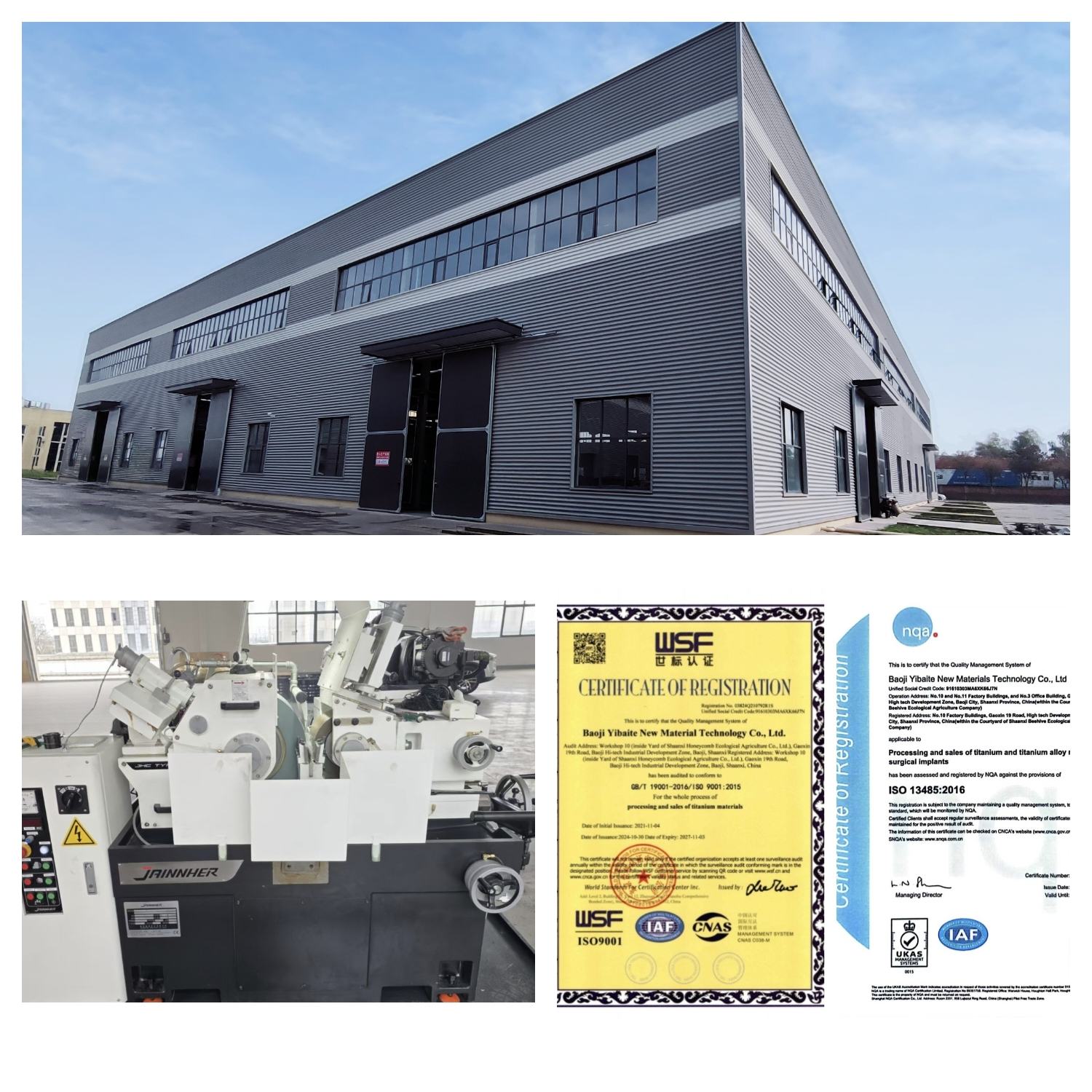
Baoji Yibaite New Materials Technology Co., Ltd. is a high-tech titanium processing company in Baoji, Shaanxi Province - China's Titanium Valley.
We manufacture titanium products from carefully melted and processed ingots, through forging, rolling, drawing, and finishing - maintaining quality control at every stage.
What we supply:
- Titanium bars and rods - for machining, forging, and component fabrication
- Titanium plates and sheets - for structural, industrial, and formed applications
- Titanium wires - for welding, springs, and precision assemblies
- Titanium tubes and strips - for heat exchangers, piping, and specialty use
- Forgings and high-precision products - for aerospace, medical, and demanding industrial applications
Grades available:
Gr1, Gr2, Gr5 (Ti-6Al-4V), TC4, TA15, TC21, and other standard or custom specifications.
All products ship with full mill test certificates - traceable from ingot to finished product.
Baoji Yibaite New Materials Technology Co., Ltd. China's Titanium Valley - Your Trusted Titanium Partner.