


A metal that your immune system accepts, your bones grow into, and your body never rejects. Titanium alloy is the reason millions of people can walk, chew, and live without pain.
The Mystery: Why Does Your Body Accept a Metal?
Your immune system is designed to attack foreign objects. Bacteria, viruses, splinters - anything non-self triggers an inflammatory response. Yet titanium alloy can sit inside your body for decades without rejection.
The answer starts at the nanoscale.
Secret 1: The Self-Forming Shield
The moment titanium contacts body tissue, it spontaneously forms a nanometer-thin titanium dioxide (TiO₂) film on its surface. This layer is:
- Chemically inert - virtually immune to body fluid corrosion
- Ionically sealed - blocks metal ion release, preventing toxicity or allergic reaction
- Self-healing - if scratched, reforms instantly in the presence of oxygen or fluid
This passive film is why titanium is classified as a bio-friendly metal - the same reason it is trusted for surgical instruments, dental implants, cardiovascular stuns, and orthopedic joints.

Secret 2: The Immune System "Peace Treaty"
Scientists have discovered something remarkable about what happens after implantation.
Immune cells (macrophages) initially investigate the titanium surface. On a well-prepared titanium implant, these cells switch from attack mode (M1) to repair mode (M2) - signaling osteoblasts (bone-building cells) to attach and grow directly on the titanium surface.
This process is called osseointegration - the implant and your living bone literally fuse into one structure. Not a gap. Not a layer of scar tissue. A direct, load-bearing biological bond.

Secret 3: Smarter Surfaces - Titanium That Treats as Well as Supports
Modern titanium implants are no longer passive metal. Through advanced surface engineering, they are becoming active therapeutic platforms:
| Technology | What It Does |
|---|---|
| Nanoporous surface treatment | Microscale pores lock in bone cells, accelerating integration |
| Nanotube arrays | Serve as micro-reservoirs for antibiotics, growth factors, and anti-inflammatory agents |
| Slow-release drug coatings | Deliver medication locally over weeks - fighting infection and promoting healing at the implant site |
| Responsive coatings | Under development - release drugs in response to infection signals or pH changes |
The implant is no longer just a structural replacement. It is a localized treatment system.

Secret 4: 3D Printing - Implants Designed for You
The most transformative advance is additive manufacturing (3D printing), which has moved titanium implants from standardized factory products to personalized medical devices.
Using a patient's CT scan data, surgeons can now order implants custom-printed to match the exact geometry of the bone defect. But the benefits go further:
Biomimetic porous structures
3D-printed titanium implants can incorporate engineered internal porosity - a lattice structure that mimics natural bone:
| Benefit | Mechanism |
|---|---|
| Elastic modulus matching | Porosity can be tuned to match the stiffness of surrounding bone, preventing "stress shielding" - the phenomenon where a too-rigid implant causes adjacent bone to weaken and resorb |
| Bone ingrowth scaffolding | Interconnected pores act as a framework for new bone cells to crawl into, achieving deep biological integration rather than just surface bonding |

Where Titanium Is Used in Medicine
| Application | Why Titanium |
|---|---|
| Hip and knee replacements | Osseointegration, corrosion-proof, decades of service |
| Dental implants | Biocompatible with gum tissue and jawbone, no taste interference |
| Spinal fixation systems | Lightweight, fatigue-resistant, MRI-compatible |
| Cardiovascular stents | Flexible, non-thrombogenic, corrosion-proof in blood |
| Craniofacial reconstruction | Custom 3D-printed plates matching complex bone geometry |
| Surgical instruments | Lightweight, sterilizable, non-magnetic |
Every titanium medical implant - whether a stock dental screw or a custom 3D-printed cranial plate - begins as carefully processed titanium raw material. The bar, wire, plate, or powder from which it is manufactured must meet the strictest quality standards in any industry: medical-grade chemistry, mechanical properties, surface cleanliness, and dimensional precision.
Baoji Yibaite New Materials Technology Co., Ltd. is a high-tech titanium processing company in Baoji, Shaanxi Province - China's Titanium Valley. We supply titanium materials used across the medical device supply chain:
- Titanium plates and sheets - for structural, industrial, and formed components
- Titanium bars and rods - for machining, forging, and precision parts
- Titanium wires - for welding, springs, and specialty applications
- Titanium tubes - for heat exchangers, piping, and marine systems
- Titanium strips - for precision-formed components
- Forgings and high-precision products - for aerospace, energy, and demanding industrial use
Grades:
Gr1, Gr2 (preferred for consumer and food-contact products - nickel-free, biocompatible), Gr5 (Ti-6Al-4V - for high-strength applications), and custom specifications.
All products ship with full mill test certificates - because the material behind a premium product must itself be premium
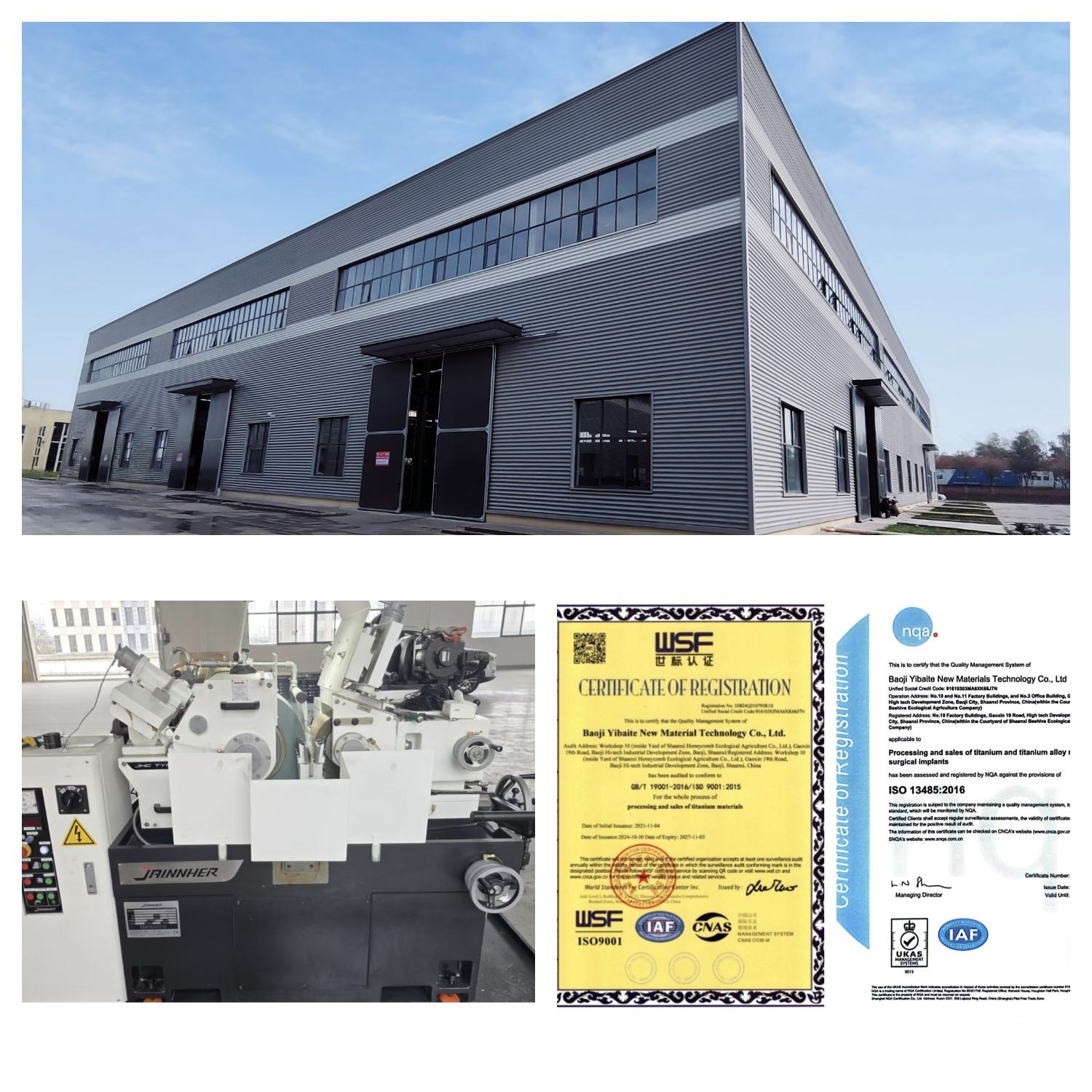
Baoji Yibaite New Materials Technology Co., Ltd. China's Titanium Valley - Your Trusted Titanium Partner.