


A titanium cup's look and feel are not natural - they are engineered. Understanding the surface treatment behind the finish helps buyers choose the right product and avoid common pitfalls.
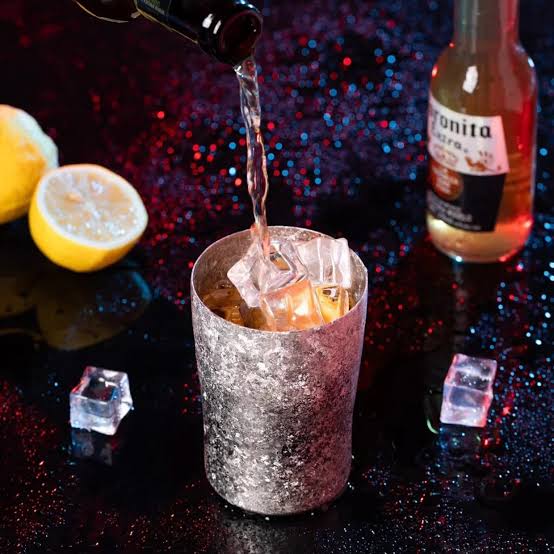
Why Surface Treatment Matters
Raw titanium is silver-gray. Exposed to air, it immediately forms a very thin oxide film that provides excellent corrosion resistance. But this natural surface is utilitarian - it shows fingerprints, water spots, and looks visually uniform.
Surface treatment transforms titanium from functional to refined:
| Purpose | What It Achieves |
|---|---|
| Aesthetics | Matte, brushed, mirror, color, crystalline textures |
| Tactile quality | Warmer grip, anti-slip, or smoother feel |
| Stain resistance | Reduced fingerprint, tea stain, and coffee residue adhesion |
| Surface hardness | Some processes increase scratch resistance |
| Enhanced protection | Thicker oxide film = better long-term corrosion resistance |
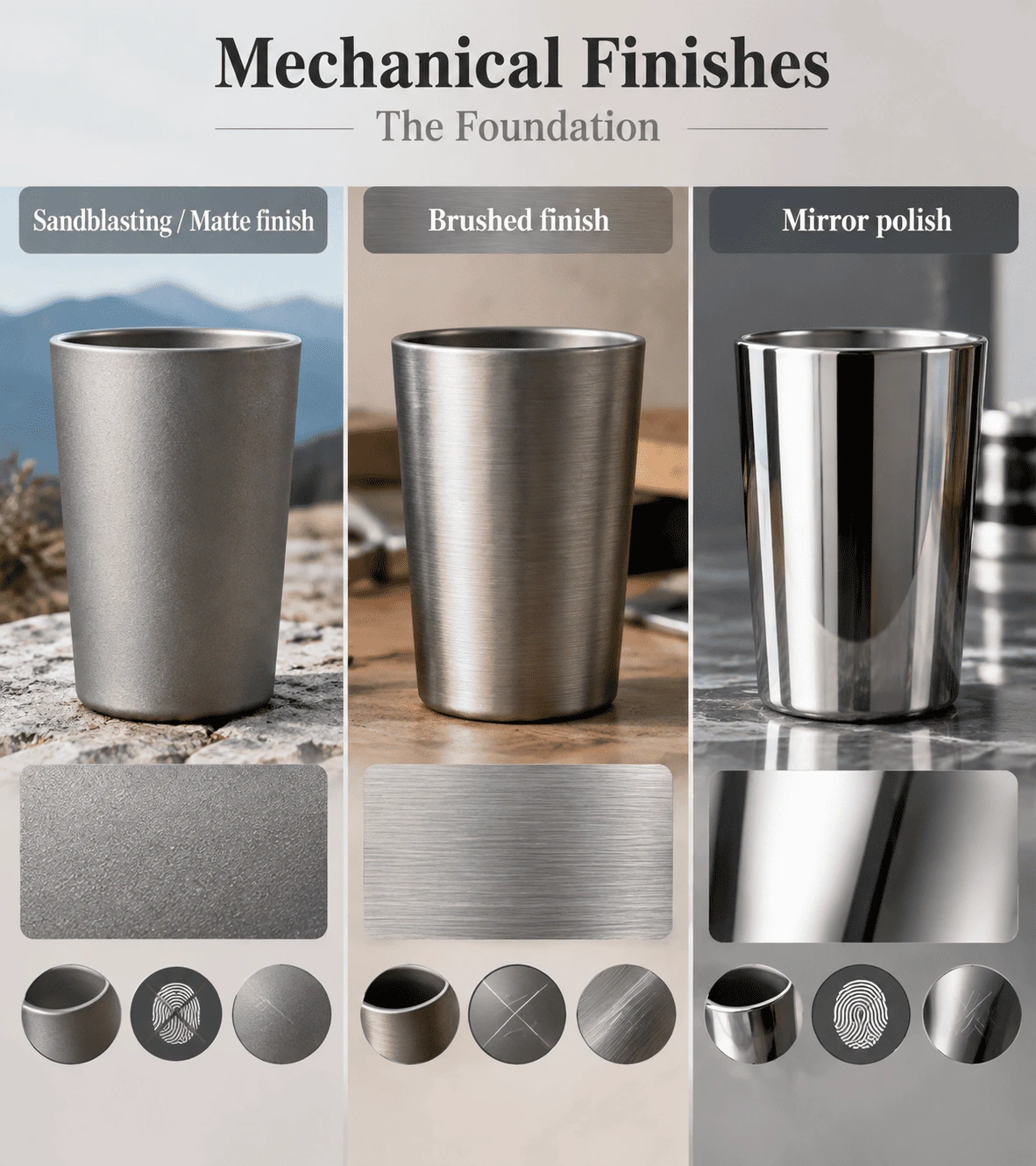
1. Mechanical Finishes: The Foundation
These processes change the surface texture through physical means - no chemistry, no coatings.
Sandblasting / Matte finish
High-speed abrasive particles blast the titanium surface, creating a uniform, fine matte texture.
- Look: Non-reflective, subtle, refined
- Feel: Smooth, slightly velvety
- Advantage: Fingerprint-resistant, scratch-tolerant, lowest maintenance
- Common use: Outdoor cups, vacuum-insulated titanium cup exteriors
Brushed finish
A sanding belt or wire wheel creates fine linear lines on the surface.
- Look: Directional metal texture - more character than matte, more understated than mirror
- Advantage: Hides minor scratches; distinctive visual identity
- Disadvantage: Grooves can trap grime - requires prompt cleaning
Mirror polish
Progressive mechanical polishing brings the titanium surface to near-mirror reflectivity.
- Look: Bright, highly reflective, unmistakably metallic
- Advantage: Smooth surface resists staining; visually striking
- Disadvantage: Shows every fingerprint and micro-scratch - highest maintenance of all mechanical finishes
2. Anodization: The Science of Color
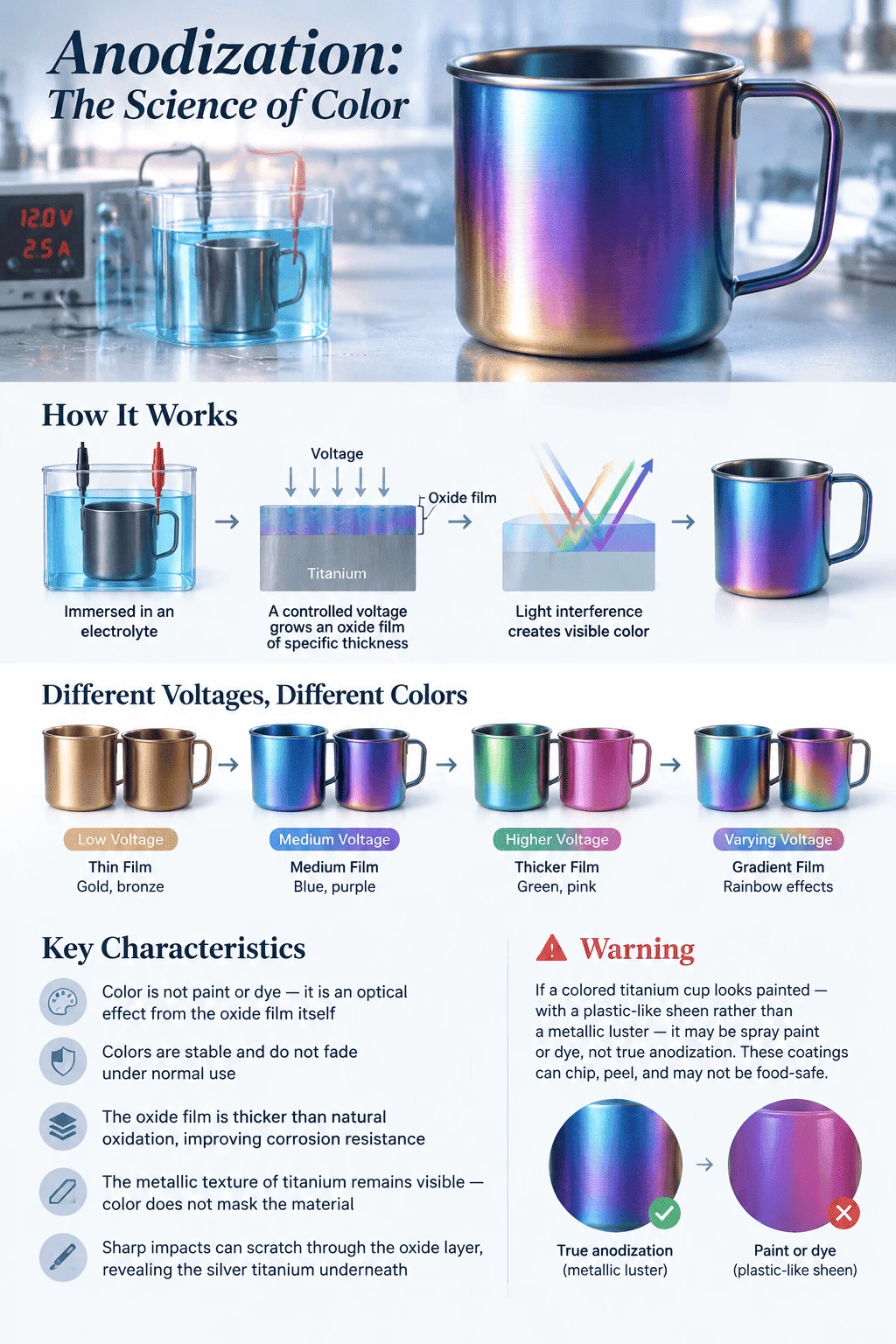
This is the core technology behind colored titanium cups - and it is widely misunderstood.
How it works: The titanium cup is immersed in an electrolyte and connected to a power source. By precisely controlling the voltage, an oxide film of specific thickness grows on the surface. This oxide film is colorless - but light interference through the film produces visible color.
| Voltage | Film Thickness | Resulting Color |
|---|---|---|
| Low | Thin | Gold, bronze |
| Medium | Medium | Blue, purple |
| Higher | Thicker | Green, pink |
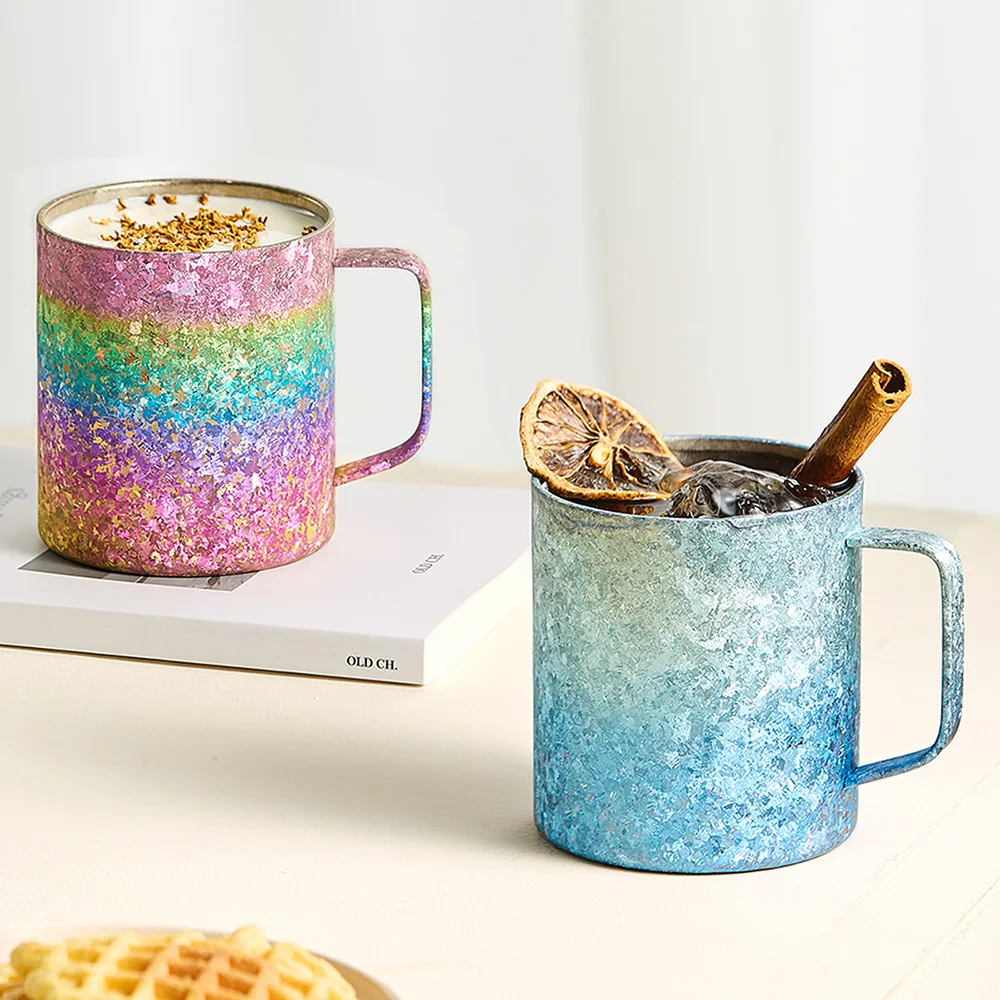
| Varying | Gradient | Rainbow effects |
Key characteristics:
- Color is not paint or dye - it is an optical effect from the oxide film itself
- Colors are stable and do not fade under normal use
- The oxide film is thicker than natural oxidation, improving corrosion resistance
- The metallic texture of titanium remains visible - color does not mask the material
- Sharp impacts can scratch through the oxide layer, revealing the silver titanium underneath
Warning: If a colored titanium cup looks painted - with a plastic-like sheen rather than a metallic luster - it may be spray paint or dye, not true anodization. These coatings can chip, peel, and may not be food-safe.
3. High-Temperature Oxidation / Nitriding / Crystallization
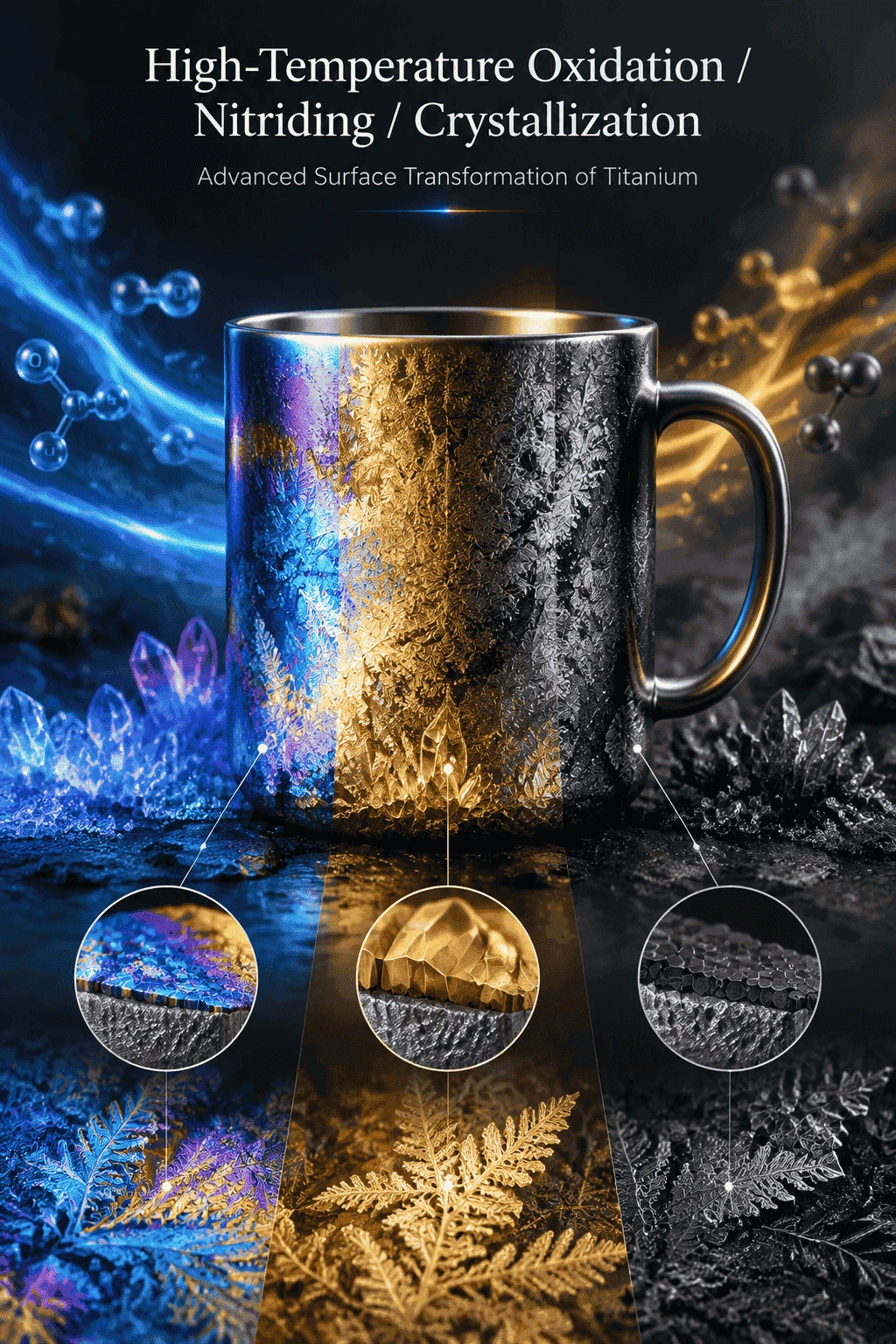
These are the processes behind the popular "ice crystal," "crystal diamond," and "crystalline texture" finishes seen on premium titanium cups.
How it works: Titanium is heated to high temperatures in controlled atmospheres containing oxygen, nitrogen, or both. The metal reacts with these gases, forming surface layers with different compositions:
| Atmosphere | Surface Layer | Typical Appearance |
|---|---|---|
| Oxygen | Titanium oxide | Blue-purple, gold, gray |
| Nitrogen | Titanium nitride | Gold - with higher surface hardness |
| Carbon + Nitrogen | Titanium carbonitride | Black, dark gray |
In vacuum or specific atmospheres, high-temperature treatment also creates crystalline surface textures - resembling frost patterns or ice flowers. These are not applied films - they are structural changes in the titanium surface itself.
Key characteristics:
- Each cup's crystalline pattern is unique - no two are identical
- Surface hardness is typically higher than pure titanium - better scratch resistance
- Colors and textures are stable - they do not peel or flake
- Common in premium and artisan titanium cups
When a brand advertises "coating-free crystalline titanium," they are referring to these high-temperature conversion layers - not spray paint or applied films.
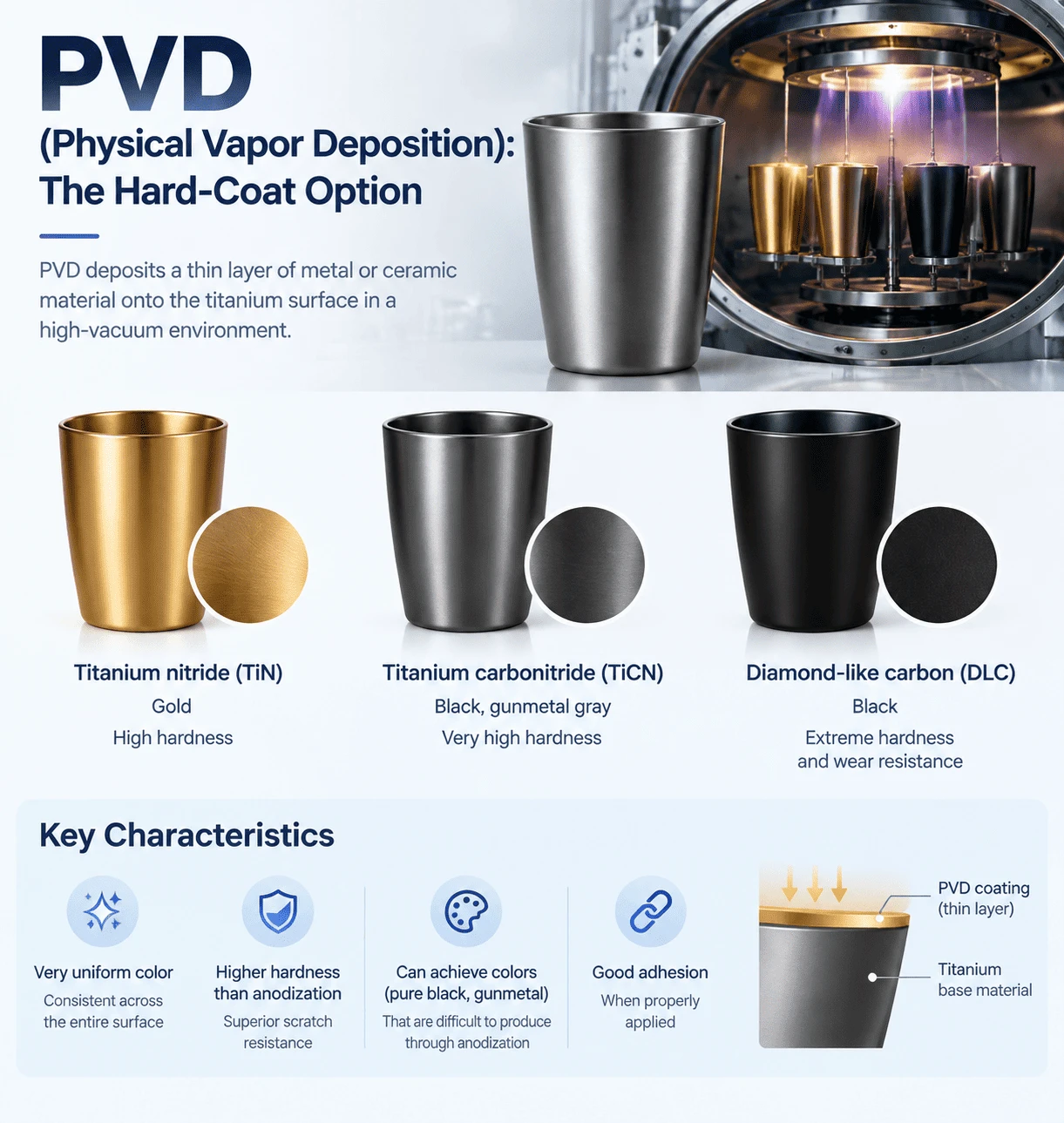
4. PVD (Physical Vapor Deposition): The Hard-Coat Option
PVD deposits a thin layer of metal or ceramic material onto the titanium surface in a high-vacuum environment.
| PVD Coating | Color | Key Property |
|---|---|---|
| Titanium nitride (TiN) | Gold | High hardness |
| Titanium carbonitride (TiCN) | Black, gunmetal gray | Very high hardness |
| Diamond-like carbon (DLC) | Black | Extreme hardness and wear resistance |
Key characteristics:
- Very uniform color - consistent across the entire surface
- Higher hardness than anodization - superior scratch resistance
- Can achieve colors (pure black, gunmetal) that are difficult to produce through anodization
- Good adhesion when properly applied
Important distinction: PVD is technically a coating - it deposits a new material onto the titanium surface. If a brand claims "coating-free" but uses PVD, that is misleading. True coating-free color comes from anodization or high-temperature oxidation only.
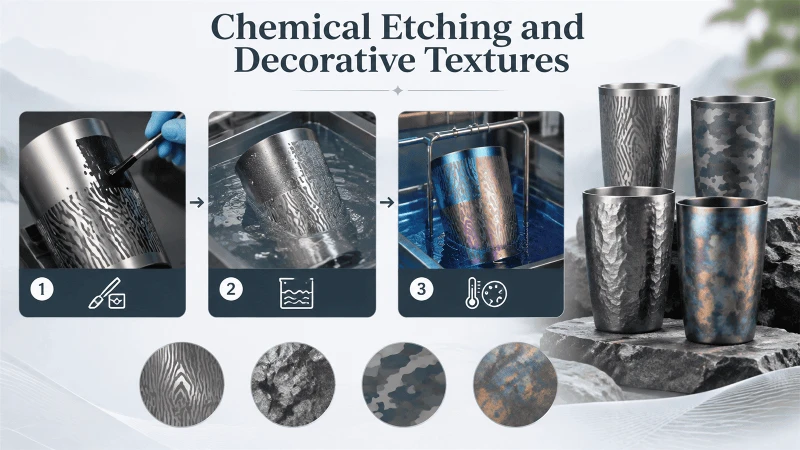
5. Chemical Etching and Decorative Textures
Some titanium cups feature wood-grain, stone-texture, camouflage, or other decorative patterns. These are typically produced by:
- 1.Applying acid-resistant ink or mask to protect selected areas
- 2.Chemical etching to create the texture in exposed areas
- 3.Combining with anodization or high-temperature treatment for color
These are highly decorative, complex, and correspondingly more expensive.
For cups produced by reputable manufacturers using proper processes:
- Anodized oxide films - stable, food-safe, no leaching
- High-temperature oxide/nitride films - chemically inert, food-safe
- PVD coatings - stable when properly applied, food-safe
Titanium itself is biocompatible - the same material used in surgical implants. Standard surface treatments do not introduce harmful substances.
But watch for:
- Extremely vivid, paint-like colors - may indicate spray paint or non-food-grade dyes
- Very cheap colored titanium cups from unknown sources - may use industrial coatings not intended for food contact
- Interior surfaces - the inside of the cup should ideally be uncolored (natural titanium, sandblasted, or simply anodized) to ensure direct food-contact safety
Daily Care: Simple but Effective
| Do | Don't |
|---|---|
| Wash with soft sponge or cotton cloth | Use steel wool or abrasive scrubbers |
| Clean tea and coffee stains promptly with baking soda or citric acid | Soak for extended periods in strong acids or alkalis |
| Dry after washing | Leave wet for extended storage |
| Handle colored cups with reasonable care | Assume anodized or PVD surfaces are scratch-proof |
Titanium cups do not require delicate treatment - they are among the most durable drinkware materials available. But the surface finish, especially colored or textured finishes, will last longer with basic care.
Choosing the Right Finish: Quick Guide
| Your Priority | Recommended Finish |
|---|---|
| Lowest maintenance, daily office/home use | Sandblasted matte - fingerprint-resistant, scratch-tolerant |
| Outdoor/camping durability | Sandblasted or high-temperature crystalline - most abrasion-resistant |
| Visual impact, gifting | Anodized color, crystalline texture, or PVD black - premium appearance |
| Maximum scratch resistance | PVD coating (TiN, DLC) - hardest surface layer |
| "No coating" purity | High-temperature oxidation/crystallization - genuine coating-free color |
Every titanium cup - regardless of its surface treatment - begins as carefully processed titanium raw material. Sheet for deep-drawn cup bodies. Bar for machined lids and components. Wire for filter screens and assembly parts.
The surface treatment quality depends on the material underneath. Consistent chemistry, uniform grain structure, and a clean, defect-free surface allow oxide films, nitride layers, and PVD coatings to form evenly. Inconsistent starting material produces inconsistent finishes - blotchy anodization, uneven color, or poor coating adhesion.
Baoji Yibaite New Materials Technology Co., Ltd. is a high-tech titanium processing company in Baoji, Shaanxi Province - China's Titanium Valley. We supply the titanium raw materials used in cup, bottle, cookware, and consumer product manufacturing:
| Product | Consumer Product Application |
|---|---|
| Titanium plates and sheets | Deep-drawn cup and bottle bodies, cookware blanks |
| Titanium bars and rods | Machined lids, stoppers, handles, hardware |
| Titanium wires | Filter screens, clips, spring components, assembly parts |
| Titanium strips | Precision-formed rims, reinforcement bands, lid edges |
Grades available:
- Grade 1 - maximum purity, best formability, optimal surface finish response - the premium choice for cups and food-contact products
- Grade 2 - industry standard - excellent balance of strength, workability, and food safety
- Custom specifications upon request
All products ship with full mill test certificates - because the material underneath the finish determines how good that finish can be.

The Takeaway
A titanium cup's surface is not an afterthought - it is an engineered system that determines appearance, durability, feel, and food safety. Understanding the difference between sandblasting and spray paint, between anodization and dye, between crystalline oxidation and PVD coating, helps buyers make informed decisions and avoid products that look similar but perform very differently.
The best titanium cup is one where the material quality, forming precision, and surface treatment all work together - starting with reliable, specification-compliant titanium raw material from the very beginning.