Many people assume titanium screws are made from an ultra-strong material - far stronger than steel. That is a misconception. The real advantage is something more nuanced, and more valuable: specific strength.

The Misconception
Titanium alloy's absolute tensile strength is roughly comparable to that of quality alloy steel (such as AISI 4340 or similar grades). Some titanium grades are slightly higher; some are slightly lower. Titanium does not dramatically "out-strength" steel.
So why does a titanium screw cost 5–10× more than a steel one? And why do engineers in aerospace, motorsport, and medical devices insist on using it?
The answer is specific strength - and it changes the calculation entirely.
Specific Strength: The Metric That Matters
Specific strength = Strength ÷ Density
It measures how much load a material can carry per unit of weight.
| Material | Density | Typical Tensile Strength | Specific Strength |
|---|---|---|---|
| Alloy steel (4340) | ~7.85 g/cm³ | ~1,000 MPa | ~127 kN·m/kg |
| Titanium alloy (Grade 5) | ~4.51 g/cm³ | ~950–1,000 MPa | ~210–220 kN·m/kg |
Same volume: similar strength.
Same weight: titanium carries roughly twice the load.
Or, stated differently: for a fastener that must carry a specific load, a titanium screw achieves it at roughly half the weight of the steel equivalent.
This is why aerospace engineers care about titanium - not because it is "stronger" than steel, but because it delivers equivalent strength at dramatically lower weight. And in aviation, every gram saved translates to fuel savings, increased payload, or extended range.
Beyond Specific Strength: The Full Advantage Set
Weight savings is the headline, but titanium screws offer additional properties that steel cannot match:
| Property | Titanium | Steel |
|---|---|---|
| Corrosion resistance | Self-passivating - immune to seawater, salt spray, and most chemicals. No coating needed | Requires plating, coating, or cathodic protection in corrosive environments |
| Magnetic behavior | Permanently non-magnetic - regardless of processing | Magnetic (or becomes magnetic after cold working) |
| Biocompatibility | Non-toxic, non-allergenic - safe for medical and food-contact applications | Nickel-containing steels can cause skin reactions |
| Fatigue resistance | Excellent under cyclic loading | Good, but degrades faster in corrosive environments |
| Temperature stability | Maintains properties from cryogenic to ~300°C+ | Performance varies significantly with grade |
These properties make titanium screws the default choice in environments where corrosion, magnetism, weight, or biocompatibility are design constraints - not just strength.


Where Titanium Screws Are Used
| Industry | Application | Primary Advantage |
|---|---|---|
| Aerospace | Airframe assembly, engine mounts, composite structure joints | Weight reduction + CFRP galvanic compatibility |
| Motorsport | Chassis, engine, suspension fasteners | Weight savings at every connection point |
| Marine and offshore | Seawater-exposed bolted connections | Corrosion immunity - no rust, ever |
| Medical devices | Surgical fixation, implant components | Biocompatibility + non-magnetic for MRI compatibility |
| Cycling and sports equipment | Frame bolts, stem clamps, seat post hardware | Light weight + corrosion resistance + premium feel |
| Electronics | Non-magnetic enclosures, precision instruments | Zero magnetic interference |
Common Titanium Screw Grades
| Grade | Composition | Typical Use |
|---|---|---|
| Grade 2 | Commercially pure titanium | Marine, chemical, and medical applications - maximum corrosion resistance |
| Grade 5 (Ti-6Al-4V) | 6% Al, 4% V | Aerospace and high-performance fasteners - the industry standard |
| Grade 9 (Ti-3Al-2.5V) | 3% Al, 2.5% V | Applications requiring better cold formability and weldability |
The Material Behind Every Titanium Fastener
A titanium screw is only as reliable as the titanium it is made from. Chemistry consistency, microstructure uniformity, and dimensional precision of the starting bar or wire directly determine whether the finished fastener meets its design specifications.
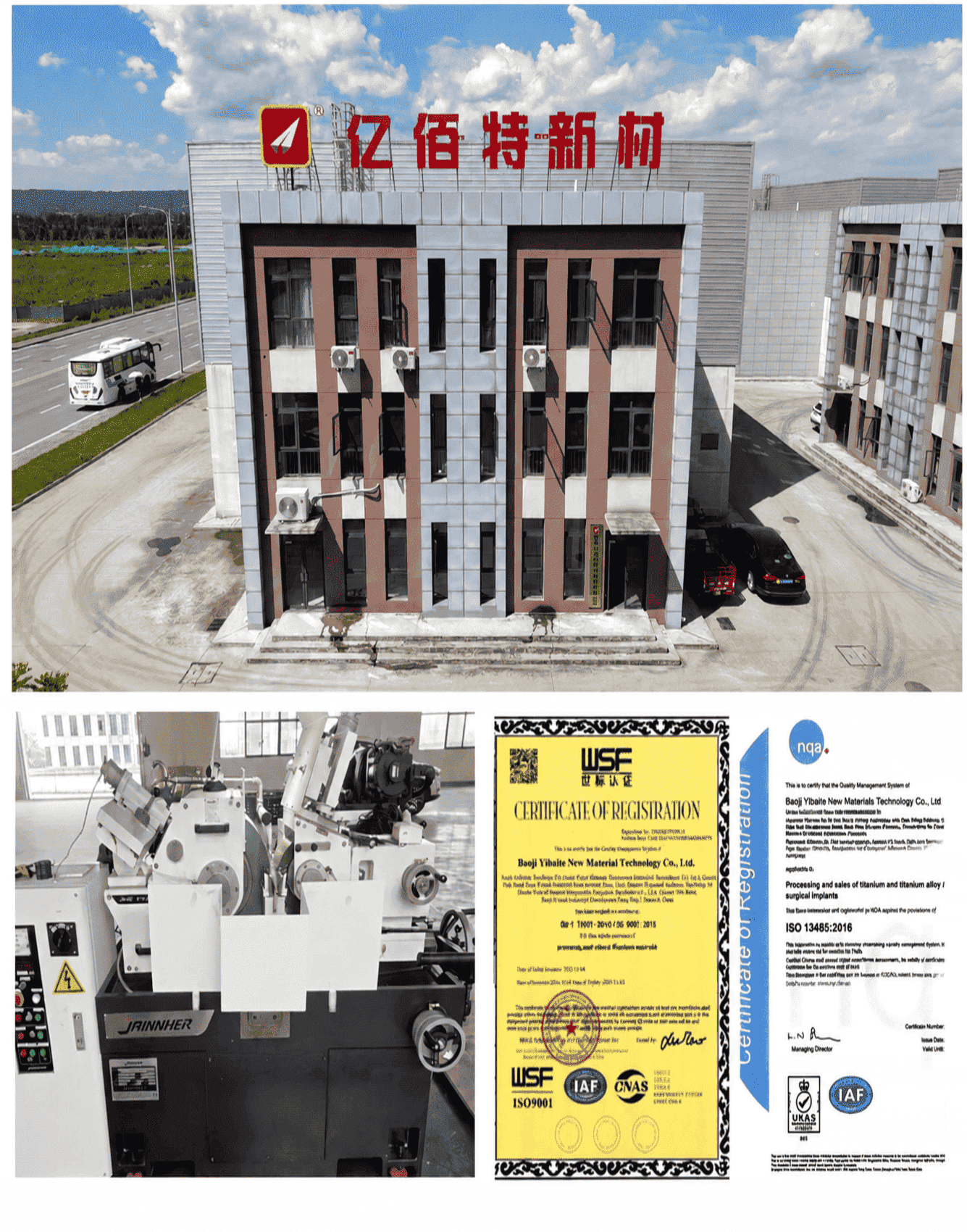
Baoji Yibaite New Materials Technology Co., Ltd. is a high-tech titanium processing company in Baoji, Shaanxi Province - China's Titanium Valley. We supply the titanium raw materials used in fastener manufacturing:
| Product | Fastener Application |
|---|---|
| Titanium bars and rods | Starting stock for heading, threading, and machined fastener production |
| Titanium wires - precision-drawn | Direct feedstock for cold-headed screws, bolts, and rivets |
| Titanium plates and sheets | Stamped washers, brackets, and flat fastener components |