


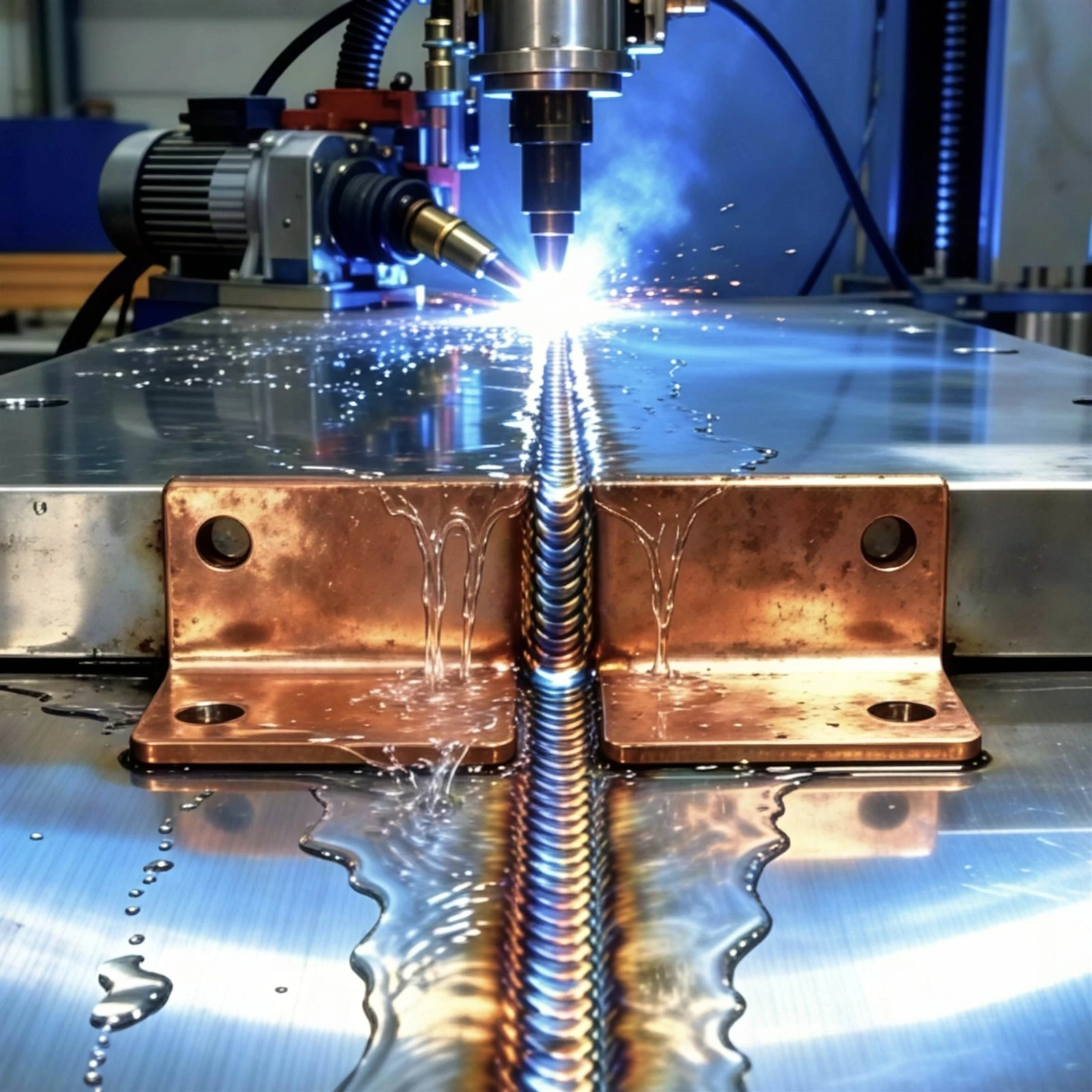
Titanium has extremely strong chemical reactivity. At high temperatures, it has a significant affinity for impurity elements such as oxygen, nitrogen, hydrogen, and carbon. When using titanium welding wire for welding, the thermal cycle will significantly increase its gas adsorption rate. If the protection and process control are improper, it is very likely to cause joint brittleness and performance deterioration. And we will find that there are different colors on the weld surface. What do these colors indicate? Let's explore it together.
The basic properties of titanium's weldability
Titanium has excellent weldability. Its thermal conductivity is approximately 0.041 Cal/(℃・cm・s), with concentrated arc heat and stable molten pool formation; its thermal expansion coefficient is 8.6×10⁻⁶/℃, much lower than that of carbon steel, resulting in small welding deformation. However, the melting point of titanium is 1668℃, requiring high heat input. At 882℃, an α→β phase transformation occurs, and the β phase grains tend to grow rapidly, leading to deterioration of joint toughness. There is no tendency for hot cracks or intergranular cracks during welding, but α+β titanium alloys are prone to generating pores, which necessitates strict control of the thermal cycle and gas protection.
The influence of impurity elements on the welding performance of titanium
Oxygen and nitrogen are embedded in the titanium lattice in the form of interstitial solid solution, causing lattice distortion, which leads to an increase in strength and hardness while sharply reducing plasticity and toughness. This is the main cause of weld cracking.
An increase in hydrogen content significantly reduces impact toughness, and the precipitation of hydrogenated titanium causes hydrogen embrittlement.
At room temperature, the solid solution of carbon reduces plasticity, and when the content exceeds the limit, it forms a network of TiC, increasing crack sensitivity. The national standard limits the carbon content of titanium alloys to ≤0.1%. Before welding, the oil stains, oxide scales, and moisture on the surfaces of the workpiece and welding wire must be thoroughly removed to avoid contamination by carbon and hydrogen increments.
Evolution of weld color and defect mechanism
The color of the weld seam changes progressively according to the degree of oxidation: silvery white (no oxidation, excellent protection) → golden yellow (TiO, slight oxidation) → blue (Ti₂O₃, moderate oxidation) → gray (TiO₂, severe oxidation).
Titanium begins to absorb oxygen at 400℃ and nitrogen at 600℃. The intrusion of oxygen and nitrogen directly leads to oxidation and nitriding. The high-temperature zone continuously adsorbs oxygen and nitrogen, forming brittle oxide layers and solid solution impurities, accompanied by an increase in hardness, a decrease in plasticity and corrosion resistance, and the darker the color, the more severe the pollution, and the poorer the quality.


The correlation between weld color quality assessment and mechanical properties
Weld color is the core indicator for rapid quality assessment on-site:
White is the best, golden yellow with dense oxidation is usually qualified;
Blue and above indicate the degree of oxidation, and the plasticity and toughness significantly decrease. Key structures need to be evaluated or reworked;
Gray/greyish white indicates severe contamination, the joint becomes brittle, and it must be removed and re-welded.
Tests have shown that color is the most intuitive representation of protection effect and contamination degree. Increased oxidation leads to an increase in weld hardness. The combined effect of oxygen and nitrogen solid solution strengthening and brittleness causes an increase in cold cracking and delayed cracking sensitivity, and the notch toughness deteriorates. Therefore, color assessment is the first quality control checkpoint, and it needs to be combined with non-destructive testing to confirm the internal quality.
Key processes and quality control points for titanium welding
Welding process must be carried out with full-process argon protection for the molten pool and the high-temperature zone above 400℃. The argon purity should be ≥ 99.99%, and the dew point temperature should be ≤ -60℃. The welding wire hydrogen content should be ≤ 0.002%. A three-in-one protection method(the welding torch nozzle, the drag cover, and backside argon filling) is adopted to prevent air turbulence from invading. The groove is machined mechanically and grinding is prohibited; high-frequency arc initiation is preferred to avoid spot welding; the heat input and the duration of high-temperature stay should be strictly controlled to inhibit the growth of β crystals. Generally, post-weld heat treatment is not performed; when necessary, the temperature should be lower than 650℃ to avoid secondary contamination.
The color of the titanium weld seam essentially represents a visual indicator of the effectiveness of high-temperature protection and the degree of impurity contamination, directly reflecting the mechanical properties and reliability of the joint. In engineering applications, a silver-white or golden-yellow color is regarded as the qualified standard, while any color above blue must be handled in accordance with the specifications. Only by coordinating the execution of gas protection, surface purification, heat input control, and tool protection can the oxidation and contamination be effectively suppressed at the root, and high-performance titanium welded joints can be stably obtained.