


A chemical reactor can be built three different ways with titanium - all-corrosion-proof solid titanium, lined steel, or explosion-bonded clad plate. The right choice depends on where the titanium goes, and the economics have a surprisingly clear threshold: 20mm.
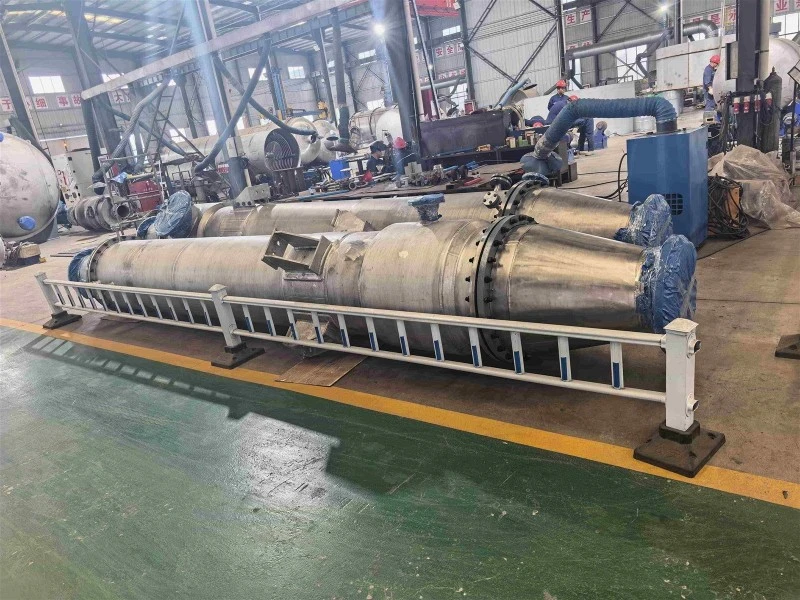
The Question Every Equipment Designer Must Answer
Titanium is expensive. Before any pressure vessel, tank, or heat exchanger is fabricated, the first question is always the same: how much titanium does this equipment actually need, and where?
Use too much titanium where it is not needed and money is wasted. Use too little and the equipment corrodes. The answer is structural design - choosing the right configuration for the operating conditions.
Three Structural Approaches
1. All-titanium construction
The entire vessel is fabricated from titanium plate. Complete corrosion resistance - but the highest material cost. Suitable when reliability is paramount and the vessel geometry is relatively simple.
2. Titanium-lined steel
A carbon steel or low-alloy steel shell carries the pressure. A thin titanium liner on the inner surface handles corrosion. Titanium provides the surface; steel provides the strength. Lower cost, suitable for moderate conditions.
3. Explosion-bonded titanium-steel clad plate
Titanium plate and steel plate are bonded through explosion welding - the enormous energy of the detonation creates a metallurgical bond at the interface, with shear strength reaching 200–275 MPa. The steel backing carries structural loads and controls cost; the titanium layer provides corrosion resistance.
Which to choose
| Operating Condition | Recommended Structure |
|---|---|
| Low pressure, moderate temperature | Titanium liner - thin titanium surface layer sufficient |
| Moderate pressure and temperature | All-titanium construction - simpler fabrication, full corrosion protection |
| High pressure, thick section, extreme conditions | Explosion-bonded clad plate - steel carries pressure, titanium resists corrosion |
Lined Vessels: From Thin Liners to Independent Inner Shells
Early lined vessels used the thinnest possible titanium liner inside a carbon steel shell - a thin corrosion barrier with all pressure carried by the steel. This worked well at low pressure and near-ambient temperatures.
But demanding conditions require a more robust approach: an independent titanium inner vessel, typically 5mm wall thickness - sufficient to support its own weight and allow full double-side welding. After testing and inspection, a carbon steel outer shell (fabricated in two halves, internally machined to match the titanium vessel OD) is assembled around it, with longitudinal and end welds completed.
The result: a pre-stressed titanium shell inside a steel casing. This approach has produced reactors with 4-meter diameter, 12-meter length, operating at 3 bar and 180°C.
For the most severe conditions, titanium-steel clad plate can be used directly. Butt welding clad plate follows a special procedure: the titanium backing is ground away on the reverse side, the steel is welded conventionally, then a titanium strip is lap-welded over the joint. Titanium cannot be directly welded to steel - but silver, compatible with both metals, can serve as an interlayer.
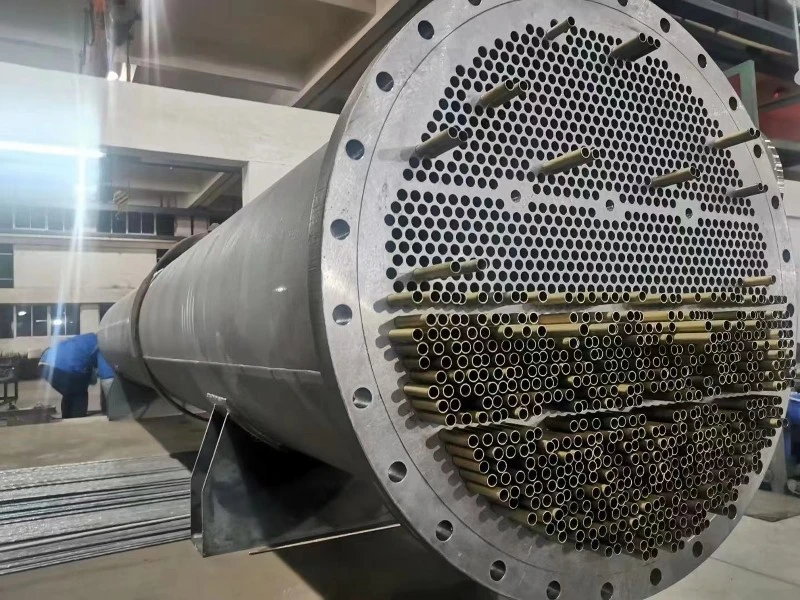
Heat Exchangers: Titanium's Classic Stronghold
If titanium equipment has a signature application, it is heat exchangers - especially seawater-cooled systems. Titanium's immunity to seawater corrosion makes it virtually unbeatable in condenser service.
| Generation | Design |
|---|---|
| Early | 1mm lined heads + 1.6mm titanium-faced carbon steel tube sheets - low pressure, low temperature |
| Modern | 100mm solid titanium tube sheets and solid heads - large-scale, high-performance |
| Advanced | Clad plate tube sheets - used when the corrosive medium is inside the tubes |
Titanium tube: thin, light, durable
High-pressure applications typically use 0.91mm and 1.2mm wall thickness. Despite being remarkably thin, tube failure in service is extremely rare - occurring only at excessively high gas velocities, where vibration-induced damage can be resolved by redesigning baffle spacing.
Tube-to-tube sheet joints use roller expansion plus seal welding: the tube is mechanically expanded into the tube sheet hole for hydraulic sealing, then seal-welded around the perimeter to prevent crevice corrosion. Tube wall thickness reduction at expansion is approximately 5% in tube sheets over 90mm thick.
Does Titanium Actually Transfer Heat Well?
This is one of the most persistent misconceptions. Titanium's thermal conductivity is indeed low - but heat exchanger performance depends on the overall surface heat transfer coefficient, not the conductivity of the tube wall alone. The metal wall resistance is a small fraction of the total thermal resistance chain.
Measured heat transfer coefficients for titanium heat exchangers:
| Service | Heat Transfer Coefficient |
|---|---|
| Cold water cooling | 425–550 W/(m²·°C) |
| Steam or hot water heating stagnant liquid | 800–1,450 W/(m²·°C) |
| Seawater-cooled condenser (0.5–1.0mm wall, velocity <3.9 m/s) | 5,400–6,800 W/(m²·°C) |
The seawater condenser numbers are remarkable - high-velocity seawater minimizes the external thermal resistance, and the thin titanium wall adds negligible resistance. The result is excellent thermal performance.
The engineering beauty of titanium equipment lies in using exactly the right amount of titanium in exactly the right place. But every successful vessel - whether a lined reactor, a clad heat exchanger, or a solid titanium column - depends on the quality of the starting titanium plate, tube, and wire.
Material consistency determines weldability. Chemistry uniformity determines corrosion performance. Dimensional precision determines fit-up and sealing integrity.
Baoji Yibaite New Materials Technology Co., Ltd. is a high-tech titanium processing company in Baoji, Shaanxi Province - China's Titanium Valley. We supply the titanium materials used in pressure vessel fabrication, heat exchanger manufacturing, and process equipment:
| Product | Equipment Application |
|---|---|
| Titanium plates and sheets | Vessel shells, liners, tube sheets, clad plate titanium layer, heads |
| Titanium tubes | Heat exchanger tube bundles, condenser tubes, process piping |
| Titanium bars and rods | Nozzles, flanges, internal fittings, machined components |
| Titanium wires | Welding consumables for vessel and heat exchanger fabrication |
| Titanium strips | Welded tube feedstock, baffle components, reinforcement bands |
All products ship with full mill test certificates - chemistry, mechanical properties, dimensions - traceable from ingot to delivered product.
Whether you are a pressure vessel manufacturer fabricating titanium reactors, a heat exchanger producer sourcing titanium tube bundles, a chemical plant operator evaluating titanium for corrosion-critical equipment, or a distributor serving the process industries - we are ready to discuss your requirements.

The Takeaway
Titanium equipment is expensive - but that expense can be engineered. Liner for moderate conditions. Solid titanium where simplicity matters. Clad plate where thickness and severity demand it. The 20mm breakeven, the 5mm inner shell, the 0.91mm tube wall - these numbers reflect precise engineering judgment about where titanium delivers value.
The art of titanium equipment design is using the minimum amount of expensive material while ensuring every corrosion-exposed surface is protected. That starts with the right titanium product in the right grade - from China's Titanium Valley.
FAQ
Q: When should I use solid titanium versus clad plate for a pressure vessel?
+
-
A: Below 20mm wall thickness, solid titanium is typically more cost-effective. Above 20mm - especially for high-pressure, high-temperature applications - explosion-bonded clad plate becomes economical, with steel carrying pressure and titanium providing corrosion resistance.
Q: Does titanium's low thermal conductivity make it a poor heat exchanger material?
+
-
A: No. Heat exchanger performance depends on the overall heat transfer coefficient, not tube wall conductivity alone. Thin titanium tubes add negligible thermal resistance - and seawater-cooled titanium condensers achieve coefficients of 5,400–6,800 W/(m²·°C), comparable to or better than conventional materials.
Q: Which titanium grade is standard for chemical process equipment?
+
-
A: Grade 2 (UNS R50400) is the industry workhorse - vessels, heat exchangers, tube sheets, and process piping. Grade 7 (Ti-0.15Pd) is used for reducing acid environments, and Grade 12 (Ti-0.3Mo-0.8Ni) for crevice corrosion-critical heat exchanger service.
Baoji Yibaite New Materials Technology Co., Ltd. China's Titanium Valley - Your Trusted Titanium Partner.
📧 stevenwei@yibaite.com.cn
📱 WhatsApp: +86 18992799610
🌐 www.ybtti.com