


Apple just announced the iPhone Duo with a titanium mid-frame and 3D-printed titanium hinge cover. This is the third time Apple has promoted titanium from accessory to structural to precision moving component. The implications for titanium material demand are enormous.
Apple did not suddenly discover titanium. The progression has been deliberate and accelerating:
| Generation | Product | Titanium Role | Significance |
|---|---|---|---|
| First | Apple Watch Ultra | Watch case - replacing steel | "Nice to have" - titanium as a premium differentiator |
| Second | iPhone 15 Pro / 18 Pro | Mid-frame - replacing stainless steel | Structural - titanium becomes the phone's skeleton |
| Third | iPhone Duo | Hinge cover - 3D-printed titanium at mass production scale | Precision moving part - titanium's most demanding role yet |
From decorative case to primary structure to a component that must survive hundreds of thousands of fold cycles without loosening or deforming. Each step increases the material performance requirement by an order of magnitude.
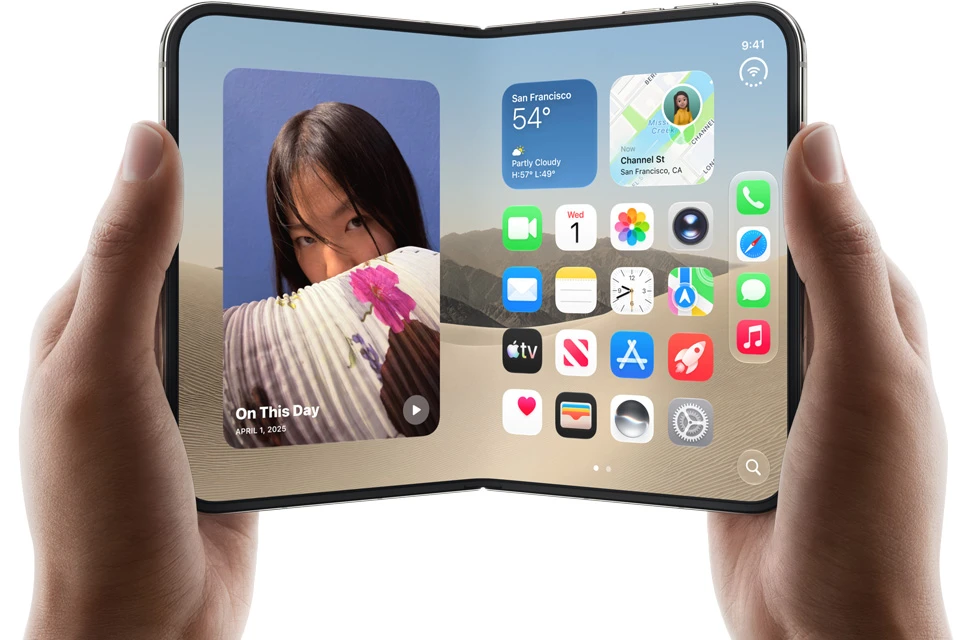

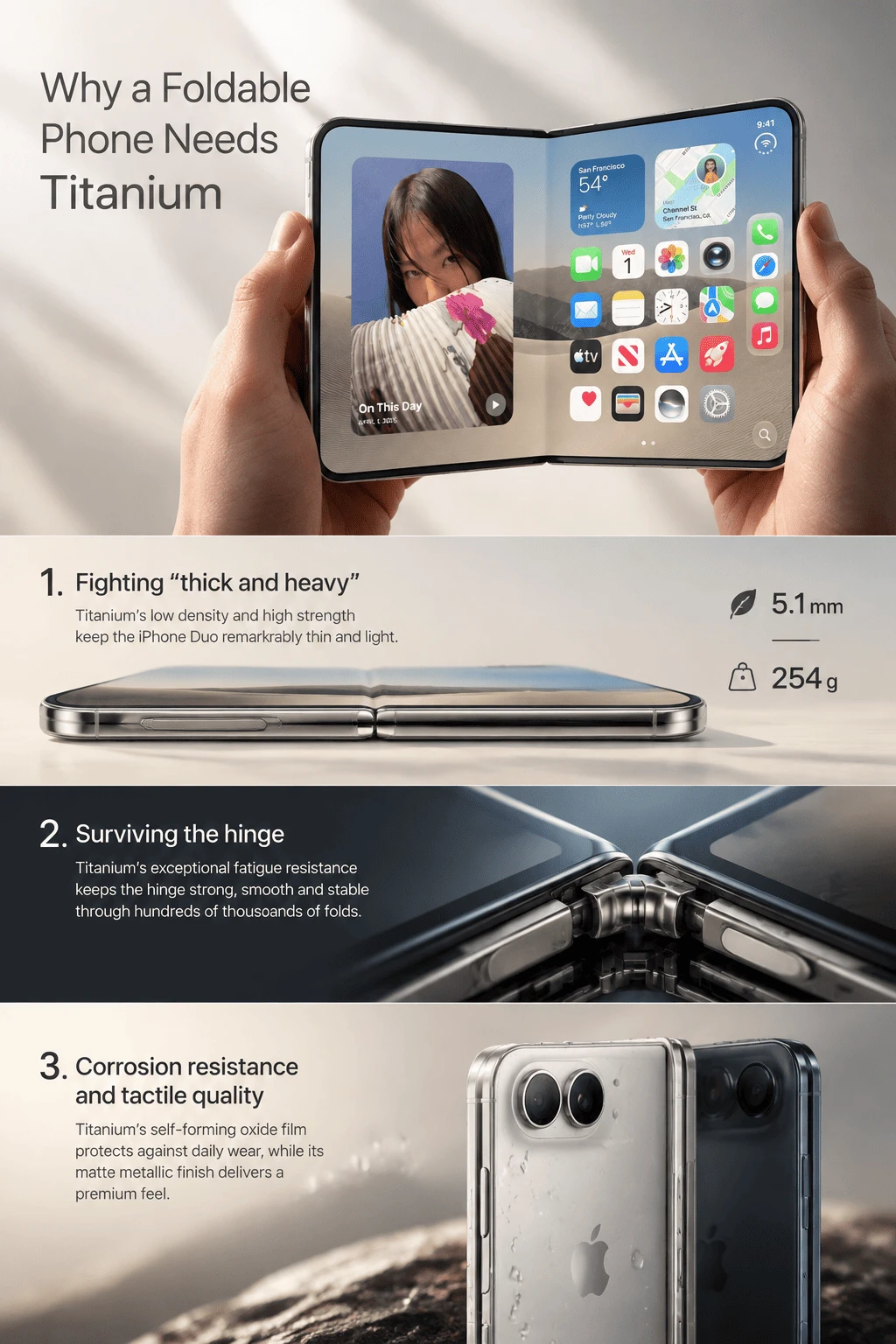
Why a Foldable Phone "Needs" Titanium
A foldable phone has an inherent disadvantage over a slab phone: it carries an extra screen and an entire hinge mechanism. Weight and thickness are the consumer's primary concerns. Titanium addresses both - and solves a third problem that no other material can.
1. Fighting "thick and heavy"
Titanium's density is approximately 56% that of steel with comparable strength. The iPhone Duo unfolds to just 5.1 mm and weighs 254 grams - figures that would be impossible with a steel mid-frame.
2. Surviving the hinge
The hinge is the foldable phone's single point of failure. It must endure hundreds of thousands of open-close cycles without developing play, stiffness, or fracture. Titanium's fatigue resistance - significantly superior to both steel and aluminum at equivalent weight - makes it one of the very few materials that simultaneously satisfies lightweight, high-strength, and long-fatigue-life requirements.
3. Corrosion resistance and tactile quality
Daily hand sweat, humid environments, pocket lint - titanium's self-forming oxide film provides permanent corrosion protection without coatings. Its matte metallic finish aligns with flagship product aesthetics.
The bottom line: For a slab phone, titanium is "better." For a foldable phone, titanium is essential.
The Grade Behind the Headlines: It Is Grade 5 (Ti-6Al-4V)
When Apple describes "aerospace-grade titanium" or "Grade 5 titanium," the material is Ti-6Al-4V - the most widely used and best-characterized titanium alloy in existence.
| Property | Value |
|---|---|
| Composition | 6% Aluminum, 4% Vanadium, balance Titanium |
| Tensile strength | 900+ MPa |
| Density | ~4.43 g/cm³ |
| Fatigue resistance | Excellent - proven across decades of aerospace service |
| Process maturity | Extremely high - well-established forging, machining, and AM parameters |
This is the same alloy used in aircraft engine compressor discs, surgical hip implants, and Formula 1 components. Apple chose it for the same reason everyone else does: proven, reliable, predictable performance.
The lesson for the titanium supply chain: consumer electronics demands the same grades as aerospace and medical. The material knowledge is already established - the new challenge is delivering it at consumer electronics volume and precision.
What This Means for the Titanium Industry
| Dimension | Impact |
|---|---|
| Demand volume | A single foldable phone program at 10M units creates structural titanium demand far exceeding traditional consumer electronics |
| Product form | Shift from plate and bar toward fine titanium powder for additive manufacturing |
| Quality bar | Consumer electronics batch consistency requirements rival aerospace - every unit must be identical |
| Supply chain entry | Powder producers who achieve supplier qualification for AM components gain access to a massive new market |
| Cross-sector benefit | Precision manufacturing capabilities developed for consumer electronics will elevate quality standards across aerospace, medical, and industrial sectors |
The Grade 5 titanium in Apple's iPhone Duo hinge and the Grade 5 titanium we supply from Baoji share the same fundamental chemistry: Ti-6Al-4V. The difference is in the application and the precision of the downstream processing - but the material quality requirement starts at the same place.
Whether the end product is a foldable phone hinge, a jet engine compressor disc, a surgical implant, or an industrial valve - it begins as carefully processed titanium raw material. Ingot to bar. Bar to wire, plate, tube, or powder. Every step downstream depends on the quality of the step before.
Baoji Yibaite New Materials Technology Co., Ltd. is a high-tech titanium processing company in Baoji, Shaanxi Province - China's Titanium Valley. We supply titanium materials across the full spectrum - from industrial to precision applications:
| Product | Application |
|---|---|
| Titanium bars and rods | Forging stock, CNC-machined components, powder production feedstock |
| Titanium plates and sheets | Structural panels, formed enclosures, stamped components |
| Titanium wires | Fasteners, springs, welding consumables, AM wire-feeding |
| Titanium strips | Precision-formed profiles for consumer electronics and industrial assemblies |
| Titanium tubes | Heat exchangers, process piping, specialty applications |
All products ship with full mill test certificates - chemistry, mechanical properties, dimensions - traceable from ingot to delivered product.

The Takeaway
Apple's three-step titanium journey - watch case, phone mid-frame, foldable hinge - tells a clear story: the most demanding consumer electronics company in the world is betting on titanium as a core structural material, not a premium accent.
At 10 million units, with 3D-printed titanium components entering mass production, the iPhone Duo is not an experiment. It is a market signal - one that points to dramatically growing demand for high-quality titanium bar, plate, wire, and powder.
The material is proven. The grades are established. The demand is arriving. The question for the titanium industry is not whether this market exists - it is who will be ready to supply it.
From China's Titanium Valley, we are ready.