The Problem: "Titanium" Does Not Always Mean Titanium
The titanium cup market is full of misleading claims. Some products labeled "titanium" are actually stainless steel with a thin titanium coating. Others use titanium alloy instead of pure titanium. Many carry no verifiable specifications at all.
If you are paying a premium for titanium's benefits - lightweight, corrosion-free, biocompatible - you need to confirm you are actually getting them.
Three simple checks will protect your purchase.
Check 1: The Grade - Titanium's "Identity Card"
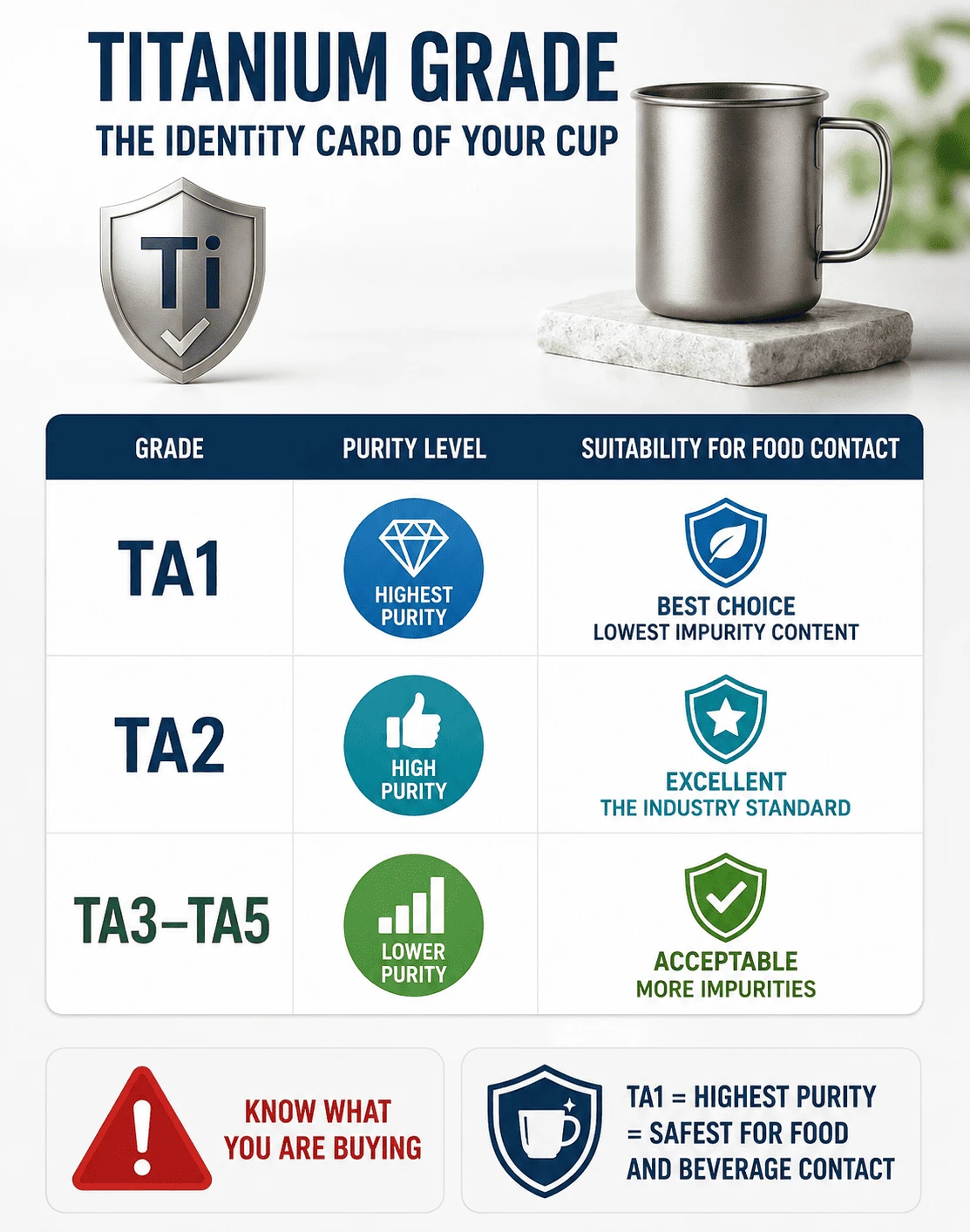
The material grade is the most direct indicator of what is inside the cup.
In the Chinese standard system, commercially pure titanium grades are designated TA1 through TA5. The lower the number, the higher the purity and the fewer the impurities.
| Grade | Purity Level | Suitability for Food Contact |
|---|---|---|
| TA1 | Highest purity | Best choice - lowest impurity content |
| TA2 | High purity | Excellent - the industry standard |
| TA3–TA5 | Progressively lower purity | Acceptable, but more impurities |
Key warning: If a product does not state its grade, or uses a designation like TC4 - that is a titanium alloy containing aluminum and vanadium, not commercially pure titanium. Alloy cups are not necessarily bad, but they are a different product at a different price point. Know what you are buying.
Simple rule: TA1 = highest purity = safest for food and beverage contact.
Check 2: The Standard - The "Legal Proof" of Material
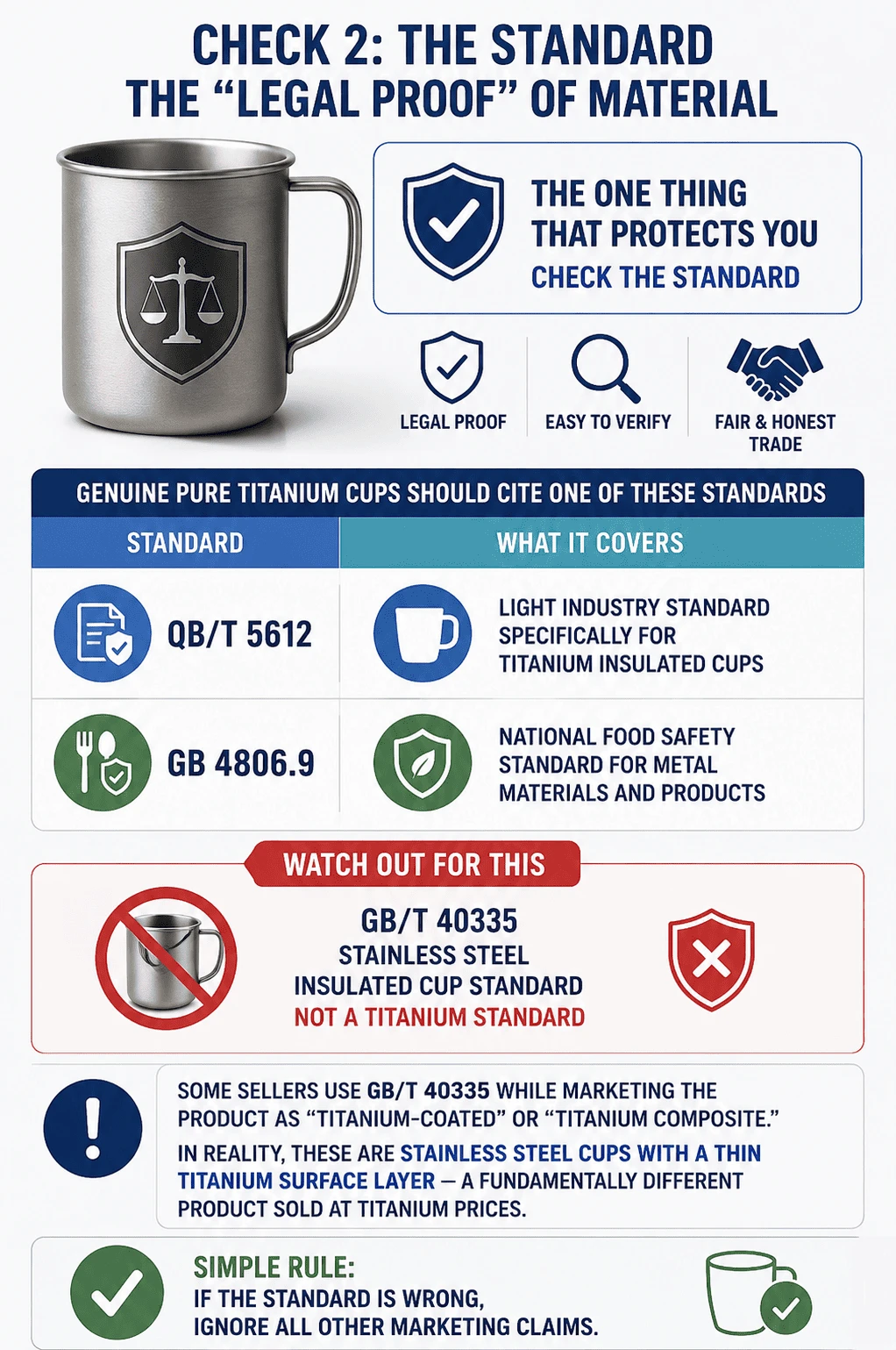
Every legitimate titanium cup should reference an executive standard on its packaging or product page. This is the single hardest thing for a dishonest seller to fake - and the easiest thing for a buyer to verify.
Genuine pure titanium cups should cite one of these standards:
| Standard | What It Covers |
|---|---|
| QB/T 5612 | Light industry standard specifically for titanium insulated cups |
| GB 4806.9 | National food safety standard for metal materials and products |
Watch out for this:
| Standard | What It Actually Is |
|---|---|
| GB/T 40335 | Stainless steel insulated cup standard - NOT a titanium standard |
Some sellers use GB/T 40335 while marketing the product as "titanium-coated" or "titanium composite." In reality, these are stainless steel cups with a thin titanium surface layer - a fundamentally different product sold at titanium prices.
Simple rule: If the standard is wrong, ignore all other marketing claims.
Check 3: The Test Report - Scientific Proof of Titanium Content
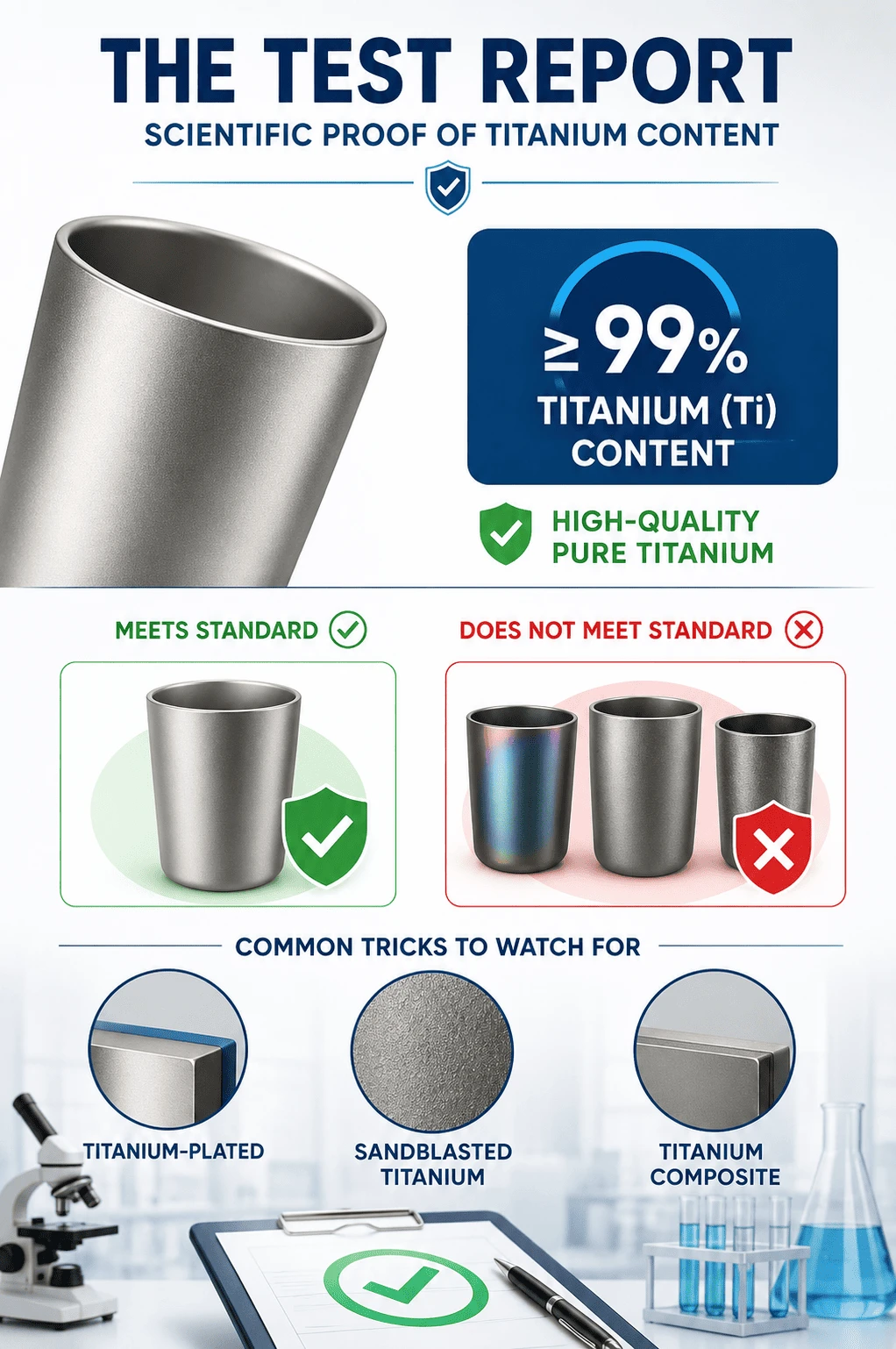
Reputable brands provide third-party laboratory test reports verifying the material composition. The single most important number to look for:
Titanium (Ti) content should be ≥ 99%
For high-quality commercially pure titanium cups, Ti content is typically 99.5% or higher.
| Ti Content | What It Likely Is |
|---|---|
| ≥ 99% | Genuine pure titanium |
| Below 99% | Possible titanium alloy, composite, or plated product |
| Not disclosed | Cannot verify - proceed with caution |
Common tricks to watch for:
- "Titanium-plated" - a micro-thin titanium layer over a cheaper base metal. Costs a fraction of solid titanium. The coating can wear off, exposing the substrate.
- "Sandblasted titanium" - a surface treatment description, not a material claim. The base material may not be titanium at all.
- "Titanium composite" - typically a thin titanium layer bonded to stainless steel. Not equivalent to solid pure titanium.
Summary: The "Three Musts" for Buying a Titanium Cup
| # | What to Check | What to Look For |
|---|---|---|
| 1 | Grade | Prefer TA1 - highest purity, safest for food contact |
| 2 | Standard | Must cite QB/T 5612 or GB 4806.9 - reject GB/T 40335 (stainless steel standard) |
| 3 | Test report | Ti content ≥ 99%, issued by a recognized third-party laboratory |
Additionally: buy from established brands with verifiable reputations. A genuine pure titanium cup is lightweight, corrosion-proof, and naturally antibacterial - but only if it is actually pure titanium. Paying titanium prices for a coated stainless steel product defeats the purpose entirely.
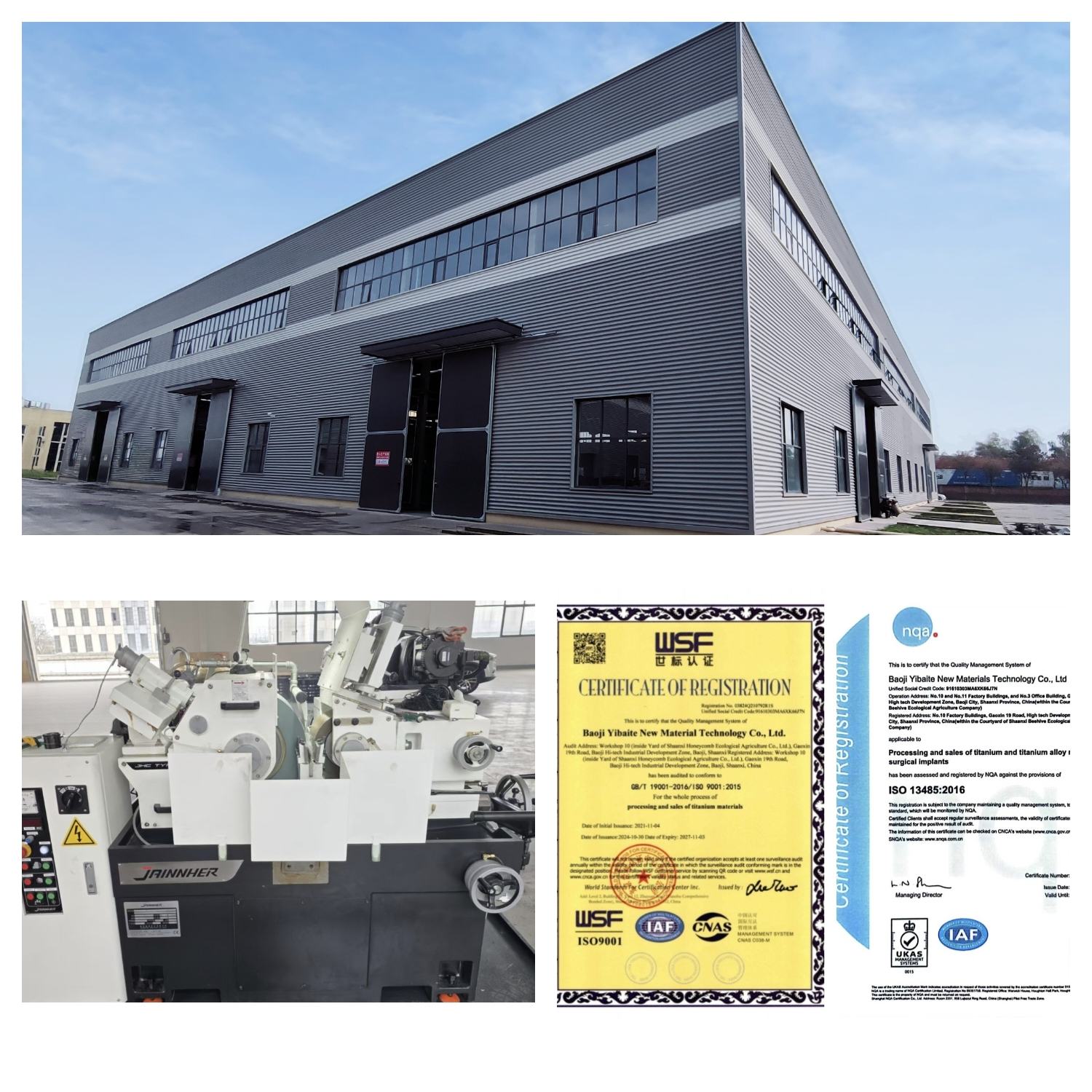
Baoji Yibaite New Materials Technology Co., Ltd. is a high-tech titanium processing company in Baoji, Shaanxi Province - China's Titanium Valley. We are part of the upstream supply chain that makes genuine titanium consumer products possible.
We supply the titanium raw materials used in cups, cookware, tableware, and other consumer products:
- Titanium plates and sheets - for stamped and formed cup bodies
- Titanium bars and rods - for machined lids and components
- Titanium wires - for filters and fine assemblies
- Titanium tubes and strips - for specialty applications
Grades: TA1 (Gr1), TA2 (Gr2), TA3 (Gr3), TC4 (Ti-6Al-4V), and other specifications upon request.
All products ship with full mill test certificates - because material verification is not just a recommendation for consumer products. It is a requirement.
Baoji Yibaite New Materials Technology Co., Ltd. China's Titanium Valley - Your Trusted Titanium Partner.