


In 1992, two nuclear submarines collided in the North Atlantic. One was crippled. The other survived. The difference was not design - it was material.
The Collision
On February 11, 1992, the American attack submarine USS Baton Rouge (SSN-689) was conducting a routine surveillance patrol near Russia's Kola Peninsula. Its target: the Soviet Sierra-class submarine K-276 Kostroma - one of the most advanced and secretive attack submarines ever built.
The "cat-and-mouse game" ended abruptly. Kostroma's massive sail struck Baton Rouge's hull with devastating force.
The aftermath revealed a stark asymmetry:
| Submarine | Damage | Outcome |
|---|---|---|
| USS Baton Rouge (steel hull) | Catastrophic pressure hull damage | Decommissioned - repairs deemed uneconomical |
| K-276 Kostroma (titanium hull) | Sail severely damaged, but pressure hull intact | Repaired, returned to active service |
One tactical collision. Two radically different strategic outcomes. The world's navies took notice - and turned their attention to the Soviet submarine's mysterious titanium alloy armor.

Why the Soviet Union Chose Titanium
The Sierra-class submarines were among the most expensive and technically ambitious undersea weapons ever built. The Soviet Union chose titanium alloy for their pressure hulls for four decisive reasons:
1. Superior strength at lower weight
Titanium alloy achieves equivalent structural strength to high-strength steel at roughly 40% less weight - allowing submarines to carry more weapons, equipment, or achieve higher speeds.
2. Total corrosion immunity
Titanium is virtually inert in seawater. Its self-forming oxide film eliminates the extensive anti-corrosion maintenance that steel hulls require. A submarine that does not need frequent port maintenance is a submarine that stays hidden.
3. Exceptional fatigue and impact resistance
Deep-sea operations involve repeated pressure cycling - dive, surface, dive again. Titanium withstands these cycles far better than steel, and absorbs sudden extreme loads like the Kostroma collision without catastrophic failure.
4. Non-magnetic properties
Titanium dramatically reduces a submarine's magnetic signature, making it harder to detect by magnetic anomaly detection (MAD) systems - a critical advantage in anti-submarine warfare.
The manufacturing challenge
None of this came cheap. Titanium's extreme reactivity at high temperatures means all casting and welding must be performed under inert gas protection. The Soviet Union dedicated enormous national resources to solving the engineering challenges of fabricating large titanium pressure hull sections - establishing a deep-sea capability that no other nation has fully replicated.

China's Path: From Deep-Sea Exploration to National Capability
The Sierra-class story carries lessons beyond military history. Today, as China develops its deep-sea capabilities, titanium alloy plays the same foundational role:
| Program | Titanium Application |
|---|---|
| Jiaolong submersible | Titanium alloy crewed sphere - reached 7,000 meters |
| Fendouzhe submersible | New-generation titanium alloy (Ti-62A) pressure hull - reached 10,909 meters |
| Future deep-sea stations and naval programs | Titanium alloy remains the essential structural material for extreme ocean depth |
The principle is the same whether the mission is military deterrence or scientific exploration: at extreme depth, the material is the mission.
From National Defense to Everyday Products: The Same Material, Different Missions
The titanium alloy that protected Kostroma's crew at depth - and that shields Fendouzhe's scientists at the bottom of the Mariana Trench - originates from the same material ecosystem that produces everyday titanium products.
The properties that matter at 10,000 meters underwater - strength, lightness, corrosion resistance, fatigue life - are the same properties that matter in industrial equipment, chemical plants, medical devices, marine infrastructure, and consumer products.
The starting point is always the same: carefully processed titanium raw material - plates, bars, tubes, wire, and forgings - produced to exacting specifications.

Our Role: Titanium Materials from China's Titanium Valley
Baoji Yibaite New Materials Technology Co., Ltd. is a high-tech titanium processing company in Baoji, Shaanxi Province - China's Titanium Valley, the city that produces the majority of China's titanium materials.
We manufacture and supply the titanium mill products that feed into industries where material performance defines product success:
What we supply:
| Product | Applications |
|---|---|
| Titanium plates and sheets | Pressure vessels, heat exchangers, marine structures, structural panels |
| Titanium bars and rods | Machined components, forgings, fasteners, medical implants |
| Titanium wires | Welding consumables, springs, filters, precision assemblies |
| Titanium tubes | Heat exchangers, process piping, marine cooling systems |
| Titanium strips | Formed components, consumer products, precision engineering |
| Forgings and high-precision products | Aerospace, marine, energy, and demanding industrial applications |
Grades available:
Gr1, Gr2, Gr5 (Ti-6Al-4V), TC4, TA11, TA15, TC21, Ti-62A, and other standard or custom compositions.
All products ship with full mill test certificates - traceable, verifiable, specification-compliant
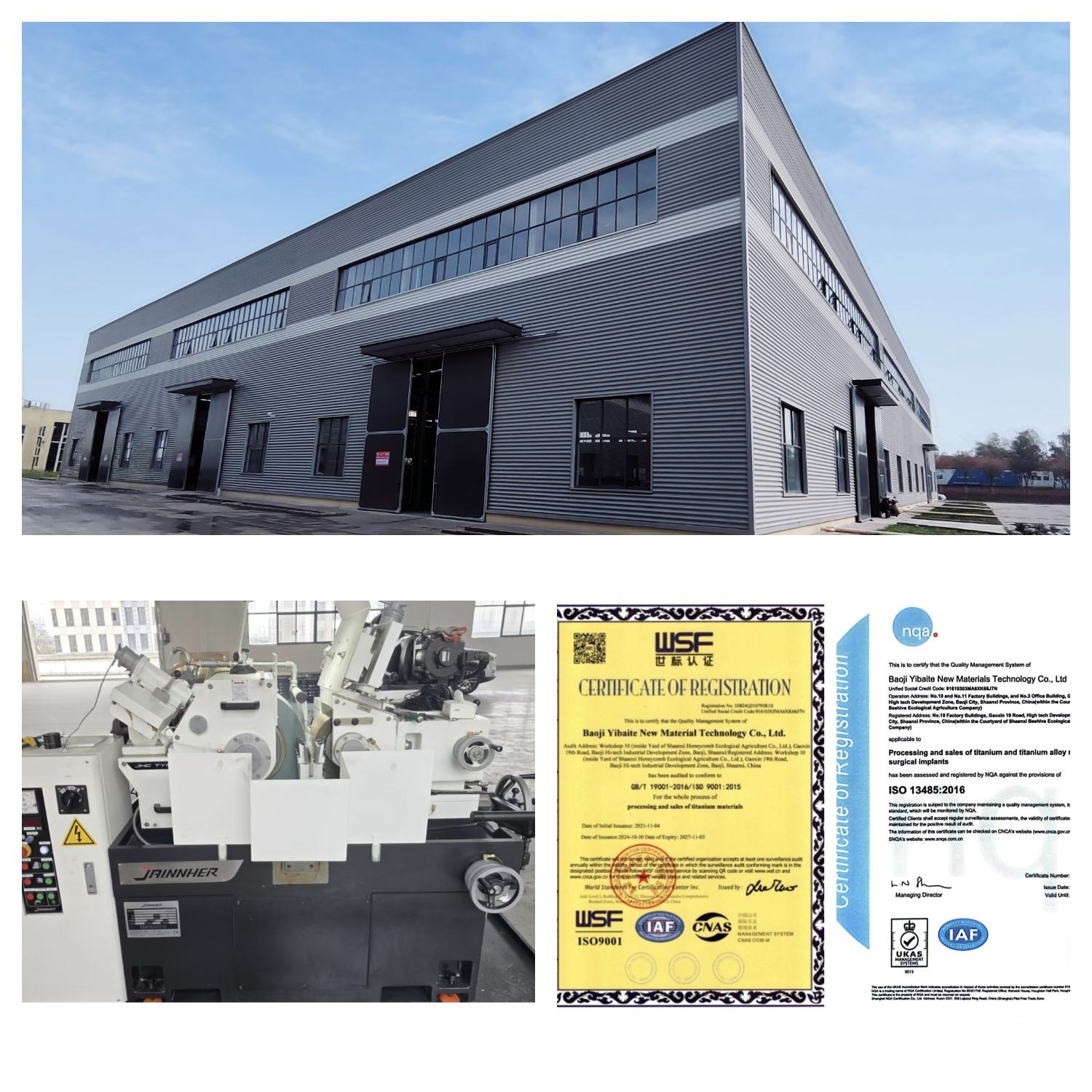
Baoji Yibaite New Materials Technology Co., Ltd. China's Titanium Valley - Your Trusted Titanium Partner.