


The same titanium alloy, processed differently, can produce fundamentally different mechanical properties. Understanding the distinction is essential for anyone specifying titanium materials.
The Core Difference
Titanium alloy can be rolled into plate, sheet, or strip through two fundamentally different approaches - each producing distinct results:
| Hot Rolling | Cold Rolling | |
|---|---|---|
| Temperature | 730–815°C (above recrystallization) | Room temperature |
| Primary goal | Large deformation + microstructure control | Dimensional precision + strength enhancement |
| Starting material | As-cast or forged billet | Hot-rolled plate/coil |
Neither is universally "better." They solve different problems - and in practice, they are often combined.
Hot Rolling: Building the Microstructure
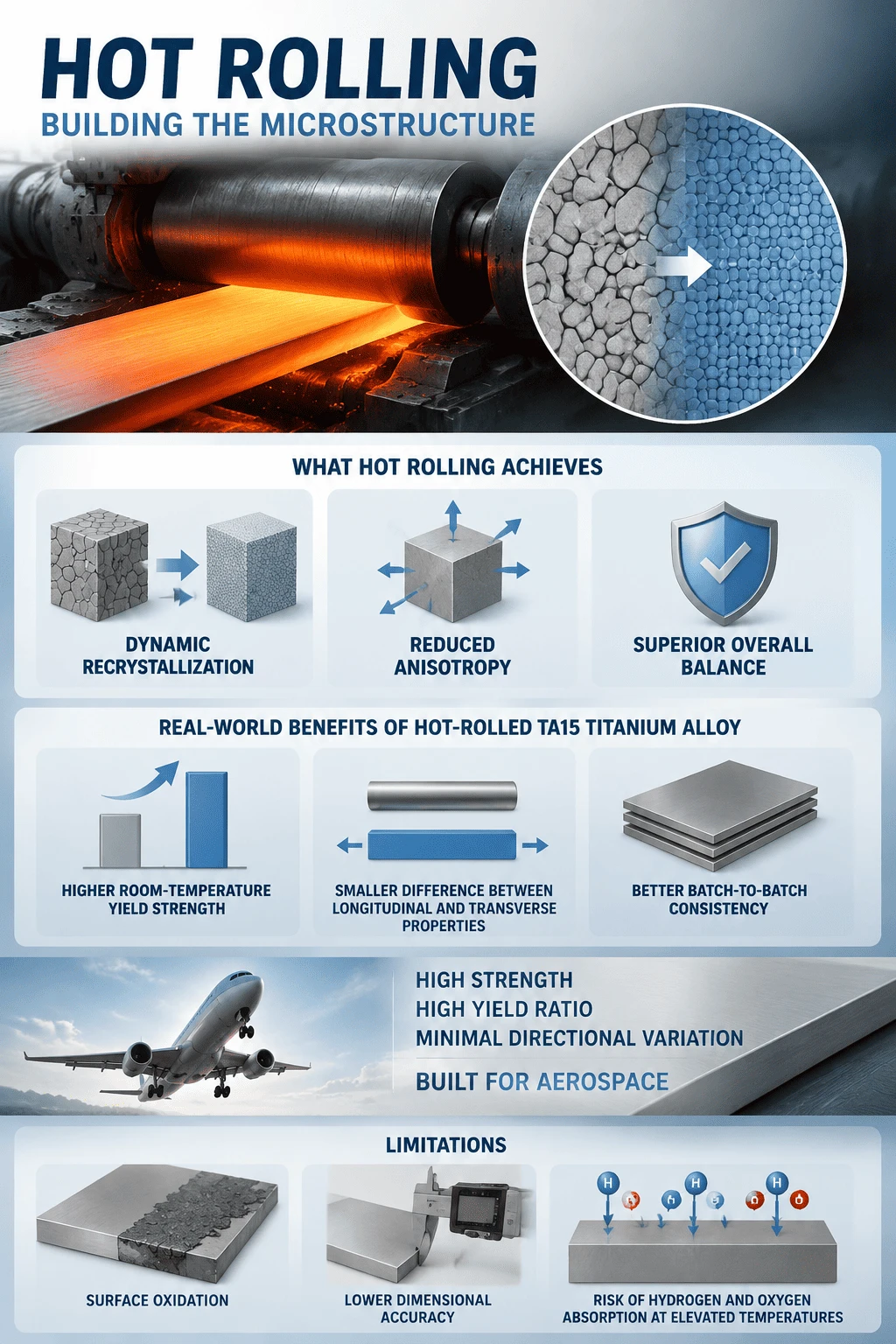
Hot rolling is performed at temperatures where titanium's crystal structure is actively recrystallizing. This is not just shaping - it is microstructure engineering.
What hot rolling achieves:
- Dynamic recrystallization - breaking down coarse cast grains into fine, uniform equiaxed structures
- Reduced anisotropy - weakening directional texture, producing more isotropic mechanical properties
- Superior overall balance - high strength combined with good ductility
.
Real-world data:
Research on TA15 titanium alloy shows that hot-rolled plate delivers:
- Higher room-temperature yield strength than cold-rolled plate
- Smaller difference between longitudinal and transverse properties
- Better batch-to-batch consistency
The result: a product characterized by high strength, high yield ratio, and minimal directional variation - exactly what aerospace structural applications demand.
Limitations:
- Surface oxidation - thick oxide scale requires subsequent removal
- Lower dimensional accuracy compared to cold rolling
- Risk of hydrogen and oxygen absorption at elevated temperatures if atmosphere control is inadequate
Cold Rolling: Precision and Hardening
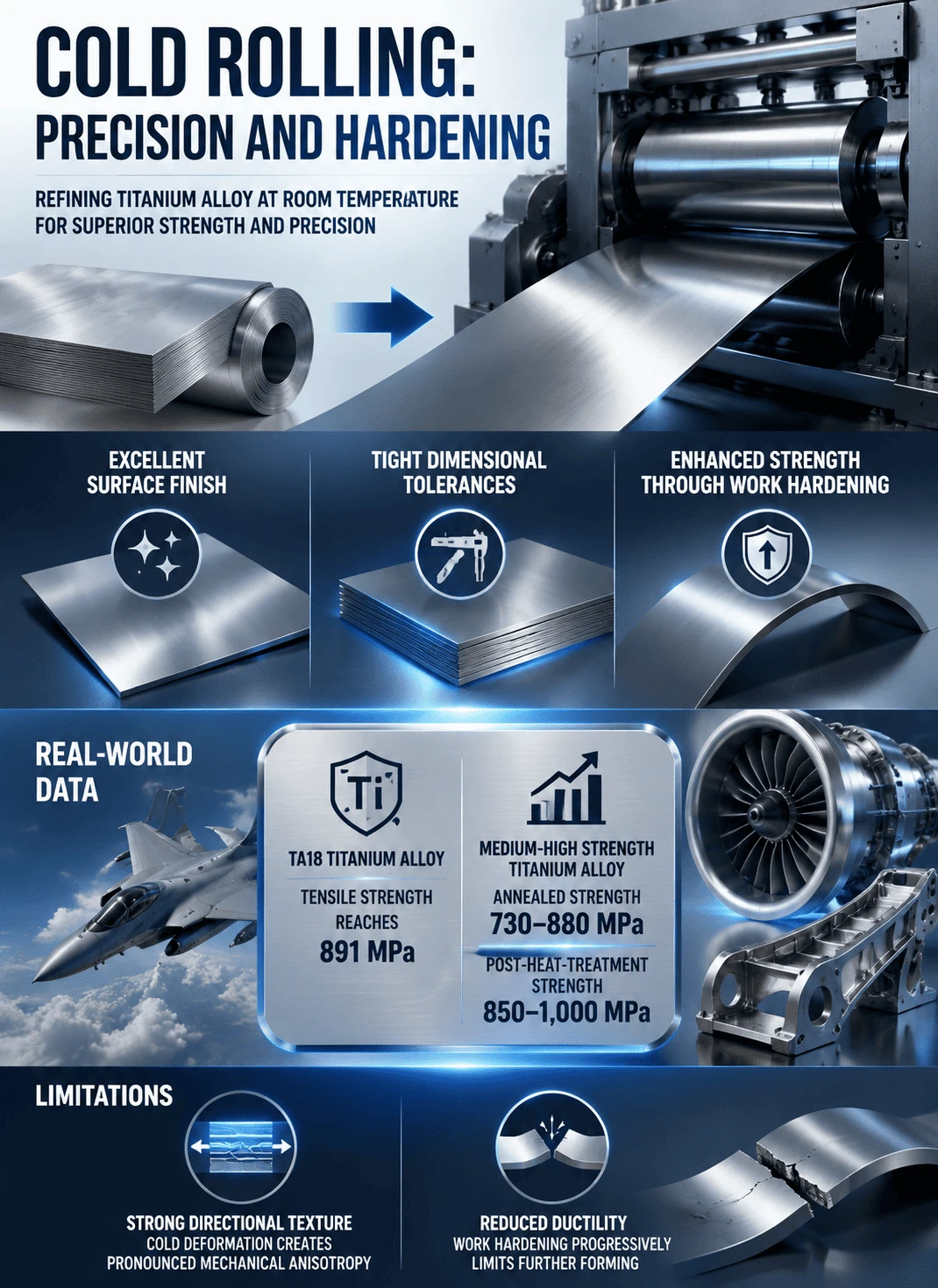
Cold rolling takes hot-rolled plate as its starting material and refines it at room temperature. The goals shift from microstructure transformation to dimensional accuracy, surface quality, and strength enhancement through work hardening.
What cold rolling achieves:
- Work hardening - dislocation multiplication increases strength significantly
- Excellent surface finish - smooth, clean, near-final quality
- Tight dimensional tolerances - micron-level thickness control
Real-world data:
- TA18 titanium alloy cold-rolled to target: tensile strength reaches 891 MPa
- A medium-high strength titanium alloy: annealed strength 730–880 MPa, post-heat-treatment strength 850–1,000 MPa
Limitations:
- Strong directional texture - cold deformation creates pronounced mechanical anisotropy
- Reduced ductility - work hardening progressively limits further forming
- Process complexity - multiple rolling passes with intermediate annealing cycles required
How They Work Together: The Industrial Standard
In production, hot rolling and cold rolling are rarely used in isolation. The standard approach is:
| Step | Purpose |
|---|---|
| Hot rolling (breakdown) | Achieve target microstructure, refine grains, establish isotropic properties |
| Cold rolling (finishing) | Achieve final thickness, surface quality, and dimensional precision |
| Annealing | Relieve residual stress, restore ductility, stabilize microstructure |
Example: TC4 (Ti-6Al-4V) plate is typically hot-rolled to intermediate gauge, cold-rolled to final thickness, then annealed - combining the microstructural benefits of hot working with the precision of cold working.
Selection Guide
| Application Requirement | Preferred Route |
|---|---|
| Aerospace structural plate - strength + isotropy + fatigue life | Optimized hot rolling with controlled thermomechanical processing |
| Precision thin sheet - tight tolerances + smooth surface | Hot rolling + cold rolling + annealing |
| High-strength strip for springs, clips, or fasteners | Cold rolling with work hardening |
| Thick plate for pressure vessels or marine structures | Hot rolling - large deformation, uniform properties |
We Supply Titanium Plate, Sheet, Strip, and Bar for All Processing Routes
Baoji Yibaite New Materials Technology Co., Ltd. is a high-tech titanium processing company in Baoji, Shaanxi Province - China's Titanium Valley.
We supply titanium materials that serve as starting stock for both hot-rolled and cold-rolled products across aerospace, marine, energy, medical, and industrial applications:
What we supply:
- Titanium plates and sheets - for structural, industrial, and formed components
- Titanium bars and rods - for machining, forging, and precision parts
- Titanium wires - for welding, springs, and specialty applications
- Titanium tubes - for heat exchangers, piping, and marine systems
- Titanium strips - for precision-formed components
- Forgings and high-precision products - for aerospace, energy, and demanding industrial use
Grades:
Gr1, Gr2, Gr5 (Ti-6Al-4V), TC4, TA15, TA18, TC21, and other standard or custom specifications.
All products ship with full mill test certificates and can be produced to your required dimensions, tolerances, and material conditions - whether you need hot-rolled plate for aerospace forgings, cold-rolled strip for precision electronics, or anything in between.
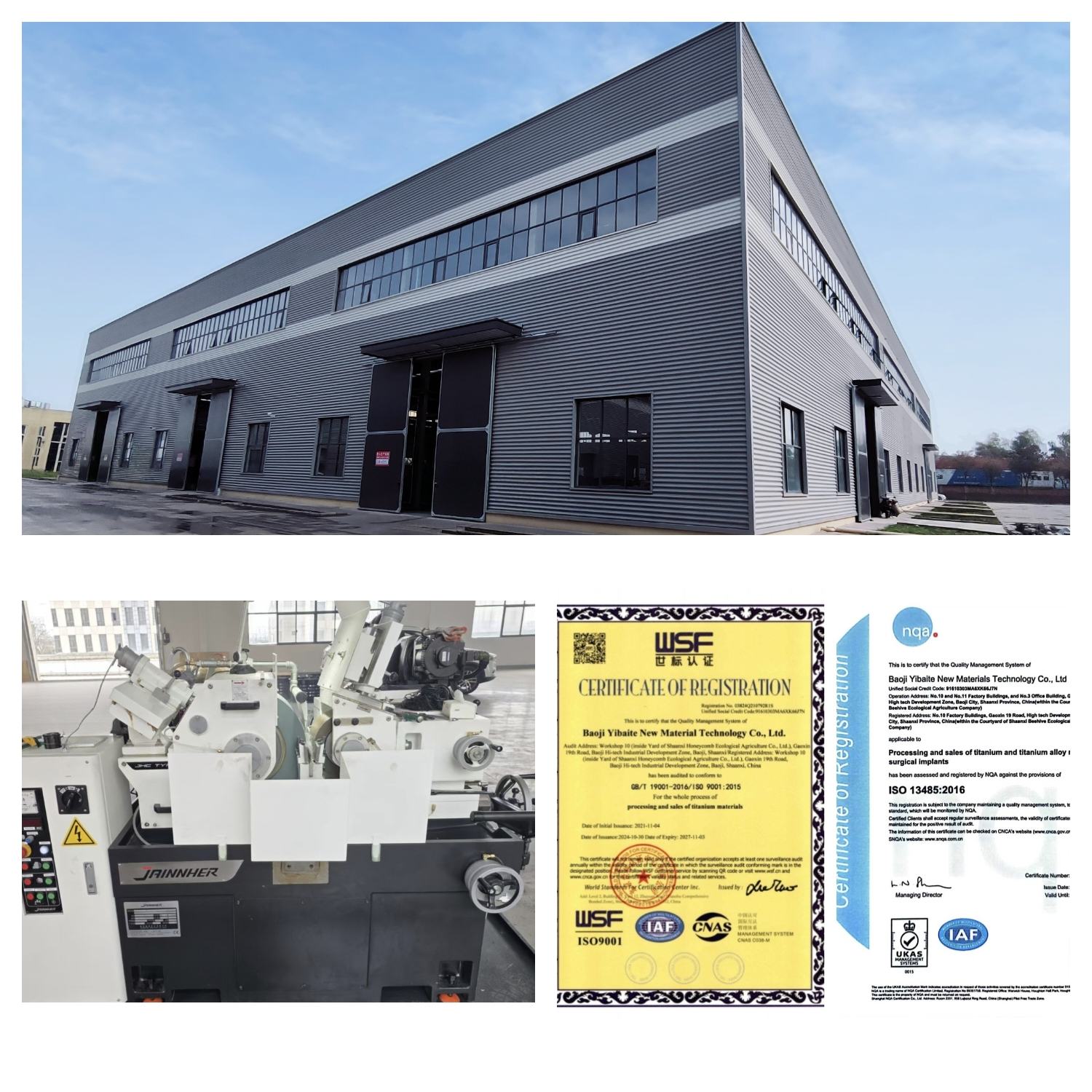
Baoji Yibaite New Materials Technology Co., Ltd. China's Titanium Valley - Your Trusted Titanium Partner.