


Why the Process Matters
Titanium bolts are used where failure is not an option - jet engines, airframes, deep-sea equipment, medical implants. A C919 commercial aircraft alone uses approximately 200,000 titanium fasteners. Every one must meet exacting standards for chemistry, strength, dimensional accuracy, and surface integrity.
The manufacturing journey from raw titanium ingot to certified bolt is long, precise, and unforgiving.
The Nine Stages
1. Raw Material: Triple-Melted Titanium Ingot
Everything begins with Vacuum Arc Remelting (VAR). Titanium ingots are typically melted three times to achieve maximum chemical uniformity and minimal impurity content.
| Grade | Application |
|---|---|
| TA2 (CP titanium) | Chemical processing, medical - corrosion resistance priority |
| TC4 (Ti-6Al-4V) | Aerospace - accounts for 95%+ of aerospace fastener volume |

2. Wire Processing: Drawing and Annealing
The ingot is processed into bar, then drawn through multiple passes to target diameter. For fine wire (below 3mm), a multi-stage annealing plus lubrication technique prevents breakage.
Vacuum annealing follows to eliminate work hardening:
| Annealing Type | Purpose |
|---|---|
| Recrystallization (700–800°C) | Restores ductility through grain restructuring |
| Homogenization | Eliminates compositional segregation from casting |

3. Acid Pickling: Surface Cleaning
A hydrofluoric-nitric acid bath removes oxide scale and surface contaminants from hot working. Followed by water rinse and neutralization - ensuring a clean surface for subsequent forming.

4. Cold or Warm Heading: Shaping the Blank
The wire is formed into a bolt blank using precision dies:
| Method | Used For |
|---|---|
| Cold heading | Beta-type alloys (TB2, TB5, Ti-45Nb) with good room-temperature ductility |
| Warm heading (650–800°C) | TC4 and other α+β alloys - reduces deformation resistance, prevents cracking |

5. Thread Formation: Rolling vs. Cutting
| Method | Advantage |
|---|---|
| Thread rolling | Cold-work hardens the thread - higher strength, efficient for high-volume production |
| Thread cutting | Higher precision for large or non-standard bolts - lower throughput |

6. Heat Treatment: Solution + Aging
High-strength bolts undergo solution treatment followed by aging:
- High-temperature solution dissolves alloying elements into the matrix
- Low-temperature aging precipitates fine α-phase particles
- Result: strength increase of 30%+
Post-treatment verification: hardness, tensile strength, and yield ratio must meet Grade 8.8 or 10.9 standards.

7. Surface Treatment: Protection and Function
| Treatment | What It Achieves |
|---|---|
| Anodization | Dense oxide film - corrosion protection + optional color |
| Micro-arc oxidation | ~5μm ceramic layer - friction coefficient drops from 0.8 to 0.15, preventing galling |
| Bead blasting / polishing | Enhanced surface finish for medical or premium consumer applications |

8. Quality Inspection: The Final Gate
The wire is formed into a bolt blank using precision dies:
|
Test |
Method |
|---|---|
| Chemical composition | Spectroscopic analysis |
| Mechanical properties | Tensile, hardness, impact testing |
| Internal defects | Ultrasonic testing |
| Surface cracks | Eddy current inspection |
| Dimensional accuracy | Verification against GB/T, ISO, AMS standards |

9. Application
Titanium bolts are now standard in:
- C919 aircraft - ~200,000 titanium fasteners per airframe
- Deep-sea submersibles - pressure hull connections
- Medical implants - bone screws and surgical fixation systems
- Chemical and marine equipment - corrosion-critical bolted joints

The Material Foundation: Where We Come In
The quality of a finished titanium bolt is directly determined by the quality of the starting material - the titanium bar or wire from which it is formed. Chemistry consistency, microstructure uniformity, and dimensional accuracy of the raw stock all propagate through every subsequent manufacturing stage.
Baoji Yibaite New Materials Technology Co., Ltd. is a high-tech titanium processing company in Baoji, Shaanxi Province - China's Titanium Valley. We supply the titanium raw materials that fastener manufacturers depend on:
- Titanium plates and sheets - for structural, industrial, and formed components
- Titanium bars and rods - for machining, forging, and precision parts
- Titanium wires - for welding, springs, and specialty applications
- Titanium tubes - for heat exchangers, piping, and marine systems
- Titanium strips - for precision-formed components
- Forgings and high-precision products - for aerospace, energy, and demanding industrial use
Grades:
Gr1, Gr2 (preferred for consumer and food-contact products - nickel-free, biocompatible), Gr5 (Ti-6Al-4V - for high-strength applications), and custom specifications.
All products ship with full mill test certificates - because the material behind a premium product must itself be premium.
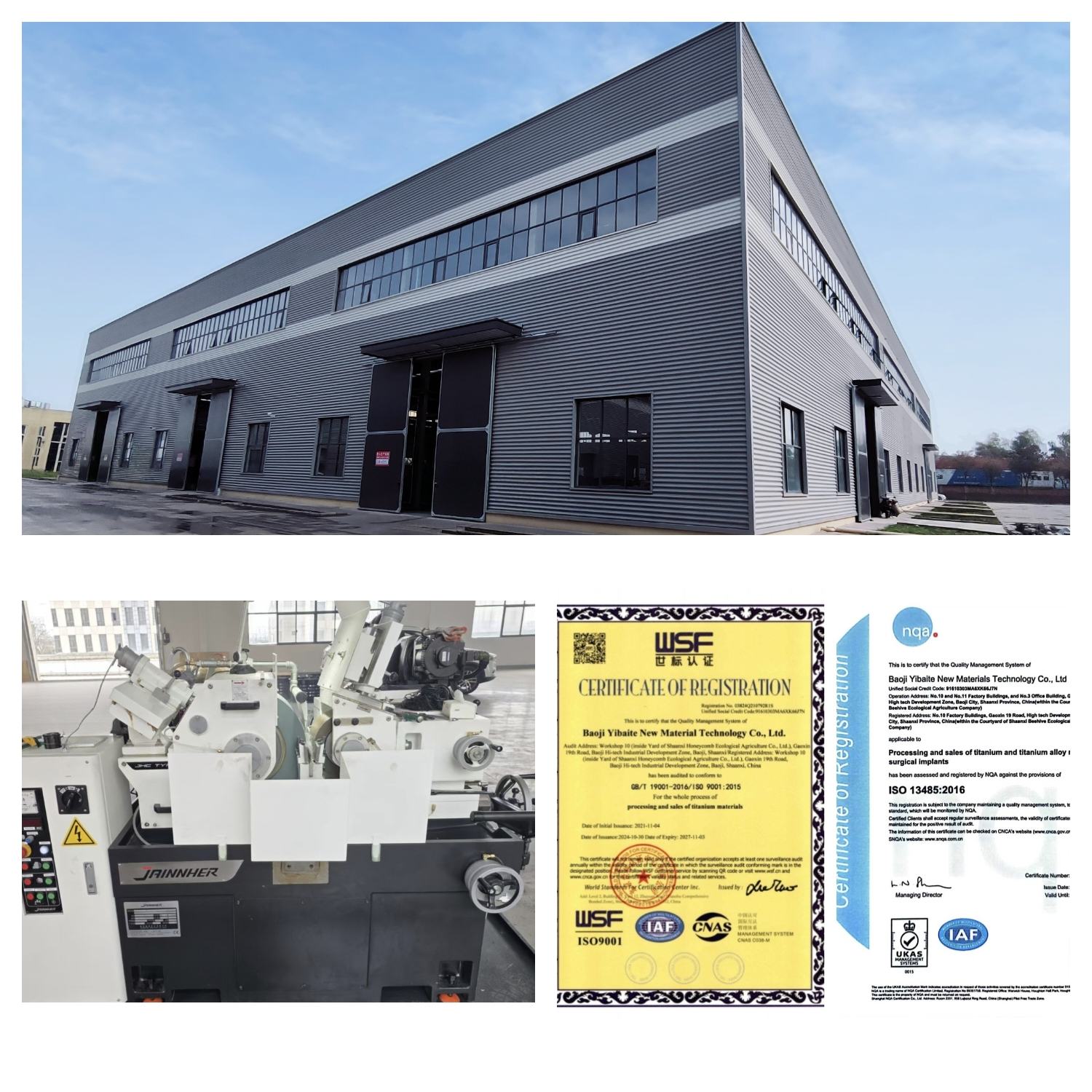
Baoji Yibaite New Materials Technology Co., Ltd. China's Titanium Valley - Your Trusted Titanium Partner.