The same titanium alloy, processed two different ways, produces two fundamentally different products. Understanding the distinction helps buyers specify the right material for their application.
The Two Routes
Titanium plate production follows one of two primary process paths - hot rolling or cold rolling. Each starts from different feedstock, follows different steps, and delivers different product characteristics.
| Dimension | Hot Rolling | Cold Rolling |
|---|---|---|
| Starting material | Cast slab or ingot breakdown | Hot-rolled coil as feedstock |
| Temperature | Above recrystallization (~730–815°C) | Room temperature |
| Primary output | Thick plate, structural plate | Thin sheet, precision-gauge strip |
| Minimum thickness | Limited by rolling mill capability | Down to ~0.18 mm |
| Surface quality | Oxide scale present - requires pickling | Smooth, clean, near-finished |
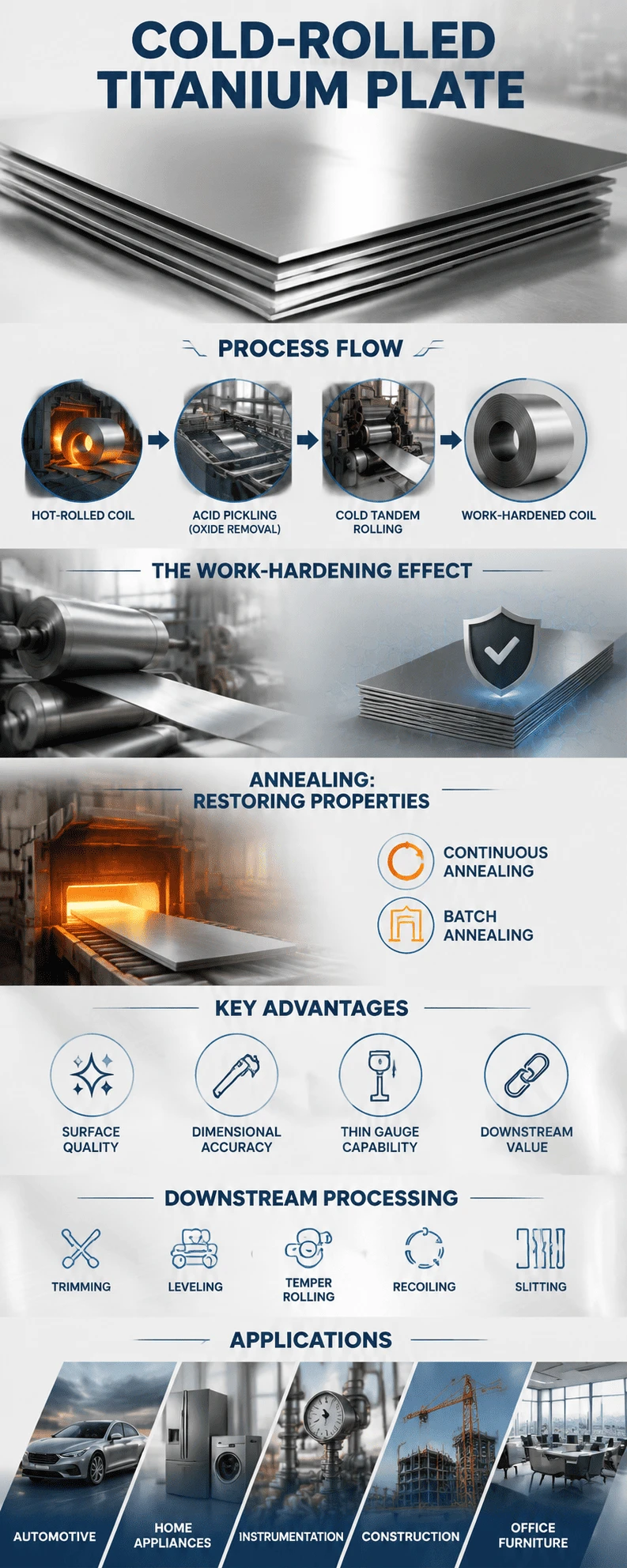
Cold-Rolled Titanium Plate
Process flow
Hot-rolled coil → acid pickling (oxide removal) → cold tandem rolling → work-hardened coil
The work-hardening effect
Cold rolling increases strength and hardness through dislocation accumulation - but reduces ductility and toughness. The resulting "hard-rolled" coil is suitable only for simple-formed parts or for downstream processing that includes annealing.
Annealing: restoring properties
To eliminate work hardening and restore formability, cold-rolled coils undergo:
- Continuous annealing (CAPL line) - for high-throughput production
- Batch annealing (box furnace) - for smaller lots or specialized requirements
Post-annealing mechanical properties meet the relevant specification standards.
Key advantages
| Advantage | Detail |
|---|---|
| Surface quality | Superior to hot-rolled - smooth, clean, visually refined |
| Dimensional accuracy | Tight thickness tolerances - micron-level control |
| Thin gauge capability | Down to ~0.18 mm - impossible to achieve by hot rolling alone |
| Downstream value | Serves as substrate for electro-galvanized, hot-dip galvanized, color-coated, PVC-laminated, and anti-fingerprint treated products |
Downstream processing
After annealing, cold-rolled coils undergo finishing operations: trimming, leveling, temper rolling, recoiling, and slitting. Final products are packaged in bundles of 3–5 tons, with coil inner diameter of 610 mm.
Applications
Automotive, home appliances, instrumentation, construction, office furniture - anywhere thin, precise, and visually refined titanium sheet is required.
Hot-Rolled Titanium Plate
Process flow
Cast slab → reheating furnace → high-pressure water descaling → roughing mill → head/tail cropping → finishing mill (computer-controlled) → laminar cooling → coiling → direct-rolled coil
Characteristics of direct-rolled coil
| Feature | Detail |
|---|---|
| Head/tail shape | Tongue-shaped and fish-tail ends - require trimming |
| Thickness/width accuracy | Lower precision than cold-rolled |
| Edge condition | May exhibit waves, folded edges, or telescoping |
| Coil weight | Heavier - coil ID typically 760 mm (preferred by tube-making industry) |
Finishing
Direct-rolled coil undergoes: head/tail cropping, edge trimming, multi-pass leveling, and temper rolling. Output products include:
- Hot-rolled plate - cut to length
- Hot-rolled leveled coil - recoiled for downstream processing
- Slit strip - cut to specified widths
Hot-rolled pickled coil: the cost-effective middle ground
When hot-rolled leveled coil is acid-pickled and oiled, it becomes hot-rolled pickled coil - a product that partially substitutes for cold-rolled plate at a lower price point. It offers improved surface quality over untreated hot-rolled material while remaining more affordable than cold-rolled products. This makes it increasingly popular across industrial applications.

Selection Guide
| Requirement | Recommended Product |
|---|---|
| Thin gauge (below ~2 mm) | Cold-rolled plate - the only option for precision thin sheet |
| High surface quality | Cold-rolled plate - smooth, clean, ready for coating or visible applications |
| Tight dimensional tolerances | Cold-rolled plate - micron-level thickness control |
| Thick plate for structural use | Hot-rolled plate - cost-effective for large-format, heavy-gauge applications |
| Cost-sensitive industrial use | Hot-rolled pickled coil - balanced performance and price |
| Deep-drawn or complex-formed parts | Cold-rolled, annealed plate - maximum ductility after treatment |
| Downstream coating or lamination | Cold-rolled plate - superior substrate for surface treatments |
We Supply Both: Hot-Rolled and Cold-Rolled Titanium Plate
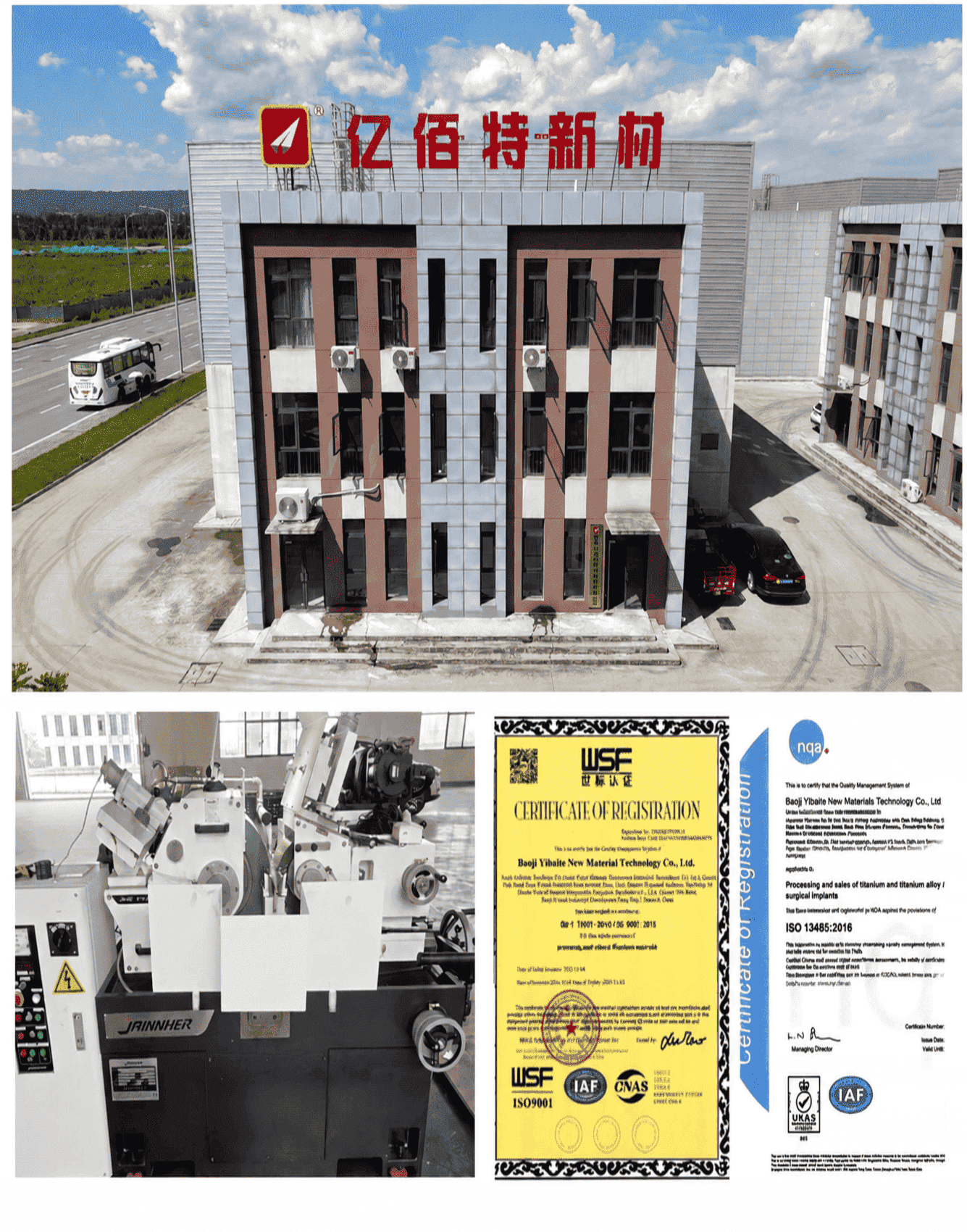
Baoji Yibaite New Materials Technology Co., Ltd. is a high-tech titanium processing company in Baoji, Shaanxi Province - China's Titanium Valley. We manufacture and supply both hot-rolled and cold-rolled titanium plate and sheet products.
Our titanium plate range:
| Product | Description |
|---|---|
| Hot-rolled titanium plate | Thick gauge, structural grade - for pressure vessels, marine structures, industrial equipment |
| Cold-rolled titanium sheet | Thin gauge, precision tolerance - for consumer electronics, medical devices, formed components |
| Hot-rolled pickled plate | Surface-cleaned hot-rolled product - cost-effective alternative for industrial applications |
| Titanium strip | Precision-rolled narrow strip - for welded tube, spring, and formed component production |
All products ship with full mill test certificates - chemistry, mechanical properties, dimensions - traceable from ingot to delivered product.
Whether you need hot-rolled plate for a chemical reactor, cold-rolled sheet for a consumer electronics component, pickled coil for an industrial application, or precision strip for welded tube production - we are ready to discuss your requirements.