


Titanium alloy golf heads have always delivered superior performance - but at a price that kept them out of reach for most golfers. Metal 3D printing is changing that equation dramatically.

Why Titanium Dominates Premium Golf
Titanium alloy's combination of properties is nearly ideal for golf club heads:
| Property | Value | Golf Benefit |
|---|---|---|
| Density | 4.43 g/cm³ - only 56% of steel | Larger head volume at manageable weight |
| Tensile strength | 1,000+ MPa | Thinner face for higher ball speed |
| Corrosion resistance | Self-passivating oxide film | Lifetime durability in all weather |
| Specific strength | Highest among common structural metals | Maximum performance per gram |
The result: higher launch efficiency, larger sweet spot, and more precise center-of-gravity control. Every premium golf brand uses titanium for their driver heads.
The Manufacturing Problem: Three Cost Mountains
Despite its performance advantages, titanium golf head production has been trapped by traditional manufacturing limitations:
1. Extreme material waste
| Process | Material Utilization |
|---|---|
| Forging | 20–30% |
| Casting | ~60% |
| 3D printing (SLM) | 95%+ |
In forging, over two-thirds of the titanium stock becomes scrap. Even casting wastes nearly half.
2. Long development cycles
Traditional mold development and prototyping requires approximately 45 days. Any design change means starting over.
3. High per-unit cost
Combined tooling, machining, material waste, and processing complexity push single-piece manufacturing costs into the hundreds or thousands of RMB - confining titanium heads to the premium niche.
The Breakthrough: Selective Laser Melting (SLM)
SLM - a metal additive manufacturing process - builds parts layer by layer by selectively melting titanium powder with a laser. It eliminates molds and most machining steps, fundamentally changing the production equation.
Material utilization: 95%+
Nearly all unused powder is recyclable. Compared to forging's 20–30%, this is an order-of-magnitude improvement.
Development time: ~7 days
No mold required. Design files go directly to the printer. From design verification to physical prototype: roughly 7 days versus 45 days traditionally.
Cost reduction: 25–40%
At production scale, SLM reduces total manufacturing cost for titanium golf heads by 25–40% compared to conventional methods.
Cost savings are the visible benefit. Design freedom is the transformative one.
Traditional manufacturing is constrained by mold geometry, tool accessibility, and assembly limitations. Many innovative internal structures are simply impossible to produce. SLM changes this completely:
| Design Capability | Performance Impact |
|---|---|
| Hollow and lattice internal structures | Significant weight reduction without sacrificing strength |
| Topology-optimized geometry | Material placed exactly where stress analysis demands it |
| Integrated thin-wall structures | Thinner striking face with internal lightweight support networks |
The measurable results:
- Part density: 99.9%+ (porosity below 0.1%)
- Head weight: ~200g - 10–20% lighter than cast equivalents
- Head volume: 2–3× larger at the same weight
- Center of gravity and moment of inertia (MOI): precisely tunable for stability and forgiveness
The design logic inverts entirely: from "what manufacturing allows us to make" to "what performance requires us to design."

Making It Industrial: The Equipment-Software-Process Triangle
Technical capability is one thing. Industrial-scale consistency is another. Reliable production of complex titanium golf heads requires a system approach:
Hardware: Industrial-grade SLM machines with high-precision optics, micron-level timing control, optimized thermal management, laminar airflow, and closed-loop oxygen control - ensuring batch-to-batch consistency
Software: AI-driven monitoring of powder spreading uniformity, scan path execution, and melt pool behavior - automatically adjusting parameters to reduce porosity and surface defects. Critically, the software enables zone-specific parameter optimization: hardening the striking face, maximizing weight reduction in the counterbalance region, and achieving precision forming in thin walls and complex internal cavities.
Process: A closed-loop workflow from design through printing to post-processing - validated and repeatable for high-complexity parts.
Whether the end product is a golf club head, an aerospace bracket, a medical implant, or a consumer electronics component - the starting point is always the same: quality titanium material.
For 3D printing applications, that means high-purity spherical titanium powder - produced from carefully processed titanium bar or billet stock through gas atomization or plasma atomization. The quality of the starting material directly determines powder chemistry, particle size distribution, and flowability - all critical to successful printing.
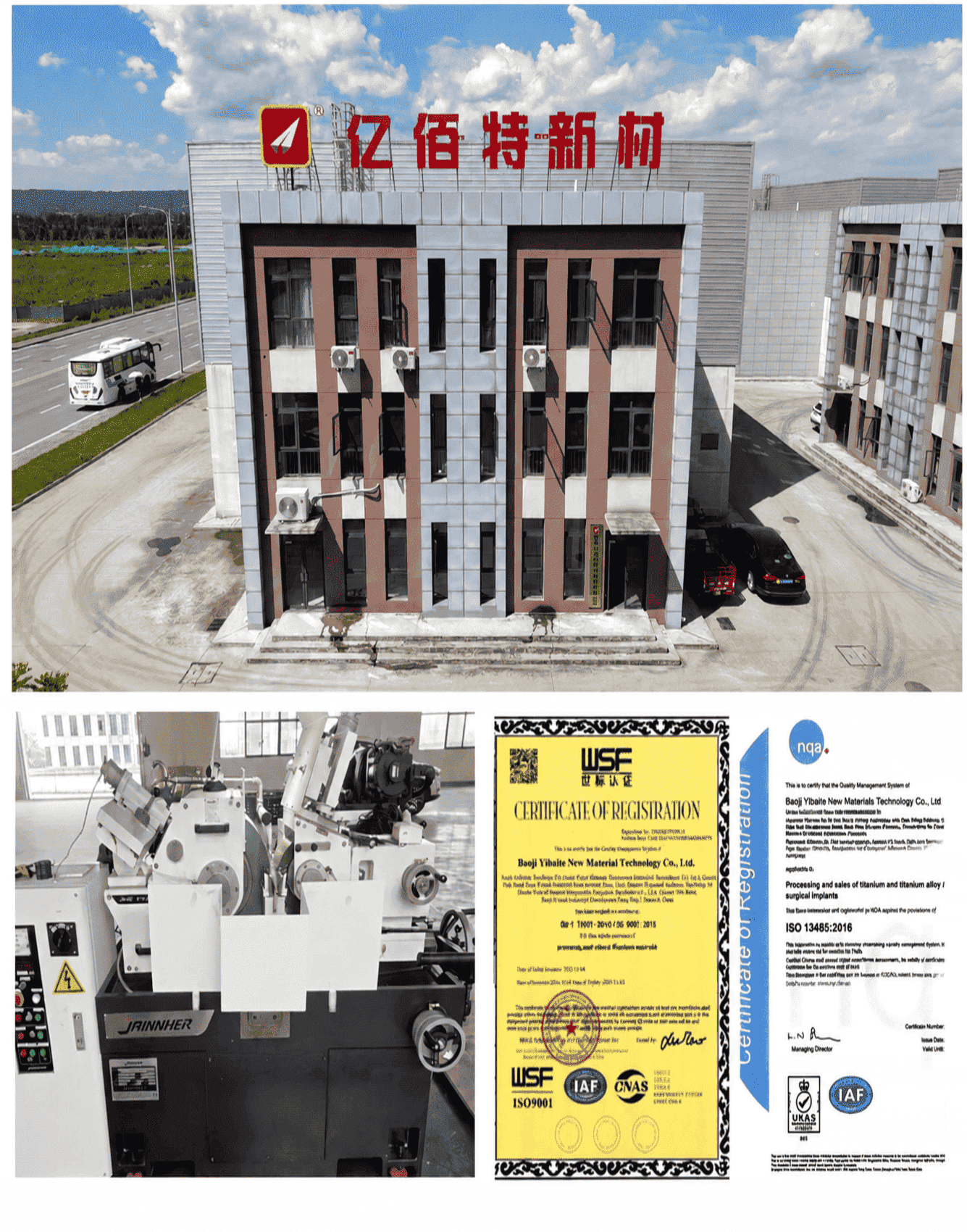
Baoji Yibaite New Materials Technology Co., Ltd. is a high-tech titanium processing company in Baoji, Shaanxi Province - China's Titanium Valley. We supply titanium materials that feed into both traditional manufacturing and additive manufacturing supply chains:
| Product | Application |
|---|---|
| Titanium bars and rods | Forging stock, machining feedstock, powder production raw material |
| Titanium plates and sheets | Structural, formed, and industrial components |
| Titanium wires | Welding, AM wire-feeding systems, precision assemblies |
| Titanium strips | Precision-formed consumer and industrial components |
The Takeaway
3D printing has not made titanium golf heads cheaper by making them worse. It has made them better - lighter, more precisely engineered, more design-optimized - while simultaneously reducing cost and lead time.
This is the same pattern playing out across every industry that uses titanium: additive manufacturing does not replace the material. It unlocks the material's full potential.
And it all starts with quality titanium - from China's Titanium Valley to the world.