A certified 3D-printed titanium part is flying on the Airbus A350 right now. And Airbus has signed a long-term deal to print many more. The implications for the entire titanium supply chain are enormous.
What Happened
Norsk Titanium and Airbus have signed a new cooperation and research agreement to industrialize Norsk's Rapid Plasma Deposition (RPD) technology for high-criticality titanium structural components. This follows the installation of a Merke IV RPD printer at Airbus's Varel, Germany facility in March 2026 - moving from evaluation to production-scale partnership in just three months.
The deal's credibility comes from a concrete milestone: a lower frame connecting component, 3D-printed by Norsk Titanium using RPD, has received dual airworthiness certification from both EASA and FAA and has completed its first flight on the Airbus A350. This is the largest and highest-criticality certified 3D-printed structural component ever to fly on a commercial aircraft.

What RPD Actually Does
RPD belongs to the Directed Energy Deposition (DED) family of additive manufacturing. A plasma arc melts titanium alloy wire in an argon atmosphere, building up material layer by layer into a near-net-shape part that requires only minimal final machining.
The key metric:
|
Process |
Material Buy-to-Fly Ratio |
|---|---|
| Traditional forging + machining | 20% material in final part - 80%+ becomes scrap |
| RPD (DED) | 50–75% improvement - less than 10% waste |
Material properties are fully equivalent to forged titanium alloy - meeting the same aerospace mechanical property specifications.
Three Signals for the Titanium Industry
1. The manufacturing logic for titanium aerospace parts is shifting
Traditional forging requires massive presses, long-cycle dies, and multi-step heat treatment. RPD achieves near-net-shape production with titanium wire and a printer. Supply chains can move from "centralized forging + global shipping" toward "local printing + rapid response."

2. Competition is moving from "tonnage" to "wire"
The old race was about sponge titanium capacity and forging press size. The new race is about high-consistency titanium alloy wire production capability and aerospace certification standards.
The global DED titanium wire market was 412 millionin 2024 and is is projected to double to1.12 billion by 2033. Whoever achieves Airbus-level process qualification first captures this high-value segment.

3.The bar has been raised for titanium suppliers worldwide
Airbus embedding RPD into its long-term production strategy sets a new benchmark. Titanium suppliers who focus only on forgings and plate risk being left behind. The additive manufacturing wire market demands a different product - precision-drawn, surface-controlled, specification-consistent titanium wire - and the certification requirements are exacting.

Global Impact
| Region | Effect |
|---|---|
| China (COMAC, AVIC) | Expected to accelerate evaluation of similar DED technologies for C919 and future programs |
| Chinese AM companies | Market demand activated, but technology gap pressure intensified |
| Russia (VSMPO-AVISMA) | Geopolitical disadvantages in Western markets amplified as AM supply chains develop locally |
| Japan, Korea | High-end titanium producers likely to accelerate partnerships with domestic AM firms to compete for DED wire market |
| Titanium recycling | RPD produces less waste with higher purity - strengthening closed-loop recycling economics |
What This Means for Titanium Material Demand
The shift from forging to deposition does not reduce titanium demand - it transforms it:
| Traditional Route | Additive Route |
|---|---|
| Titanium bar and billet → forging → machining | Titanium wire → deposition → finish machining |
| 80%+ material waste | Less than 10% waste |
| Long lead times, centralized production | Shorter lead times, distributed production |
| Large-format supply chain | Wire-based supply chain |
The products change. The quality requirements intensify. And the need for reliable, specification-compliant titanium material remains absolute.
From DED Wire to Raw Material: Our Role in the Chain
Whether a titanium aerospace component is forged from bar or deposited from wire, the starting point is always the same: carefully melted, processed, and tested titanium raw material.
For additive manufacturing, the supply chain runs: titanium ingot → bar/billet → wire drawing → surface treatment → AM-grade wire. The quality of the ingot and bar determines the chemistry, microstructure, and consistency of the final wire - and therefore the reliability of every printed part.
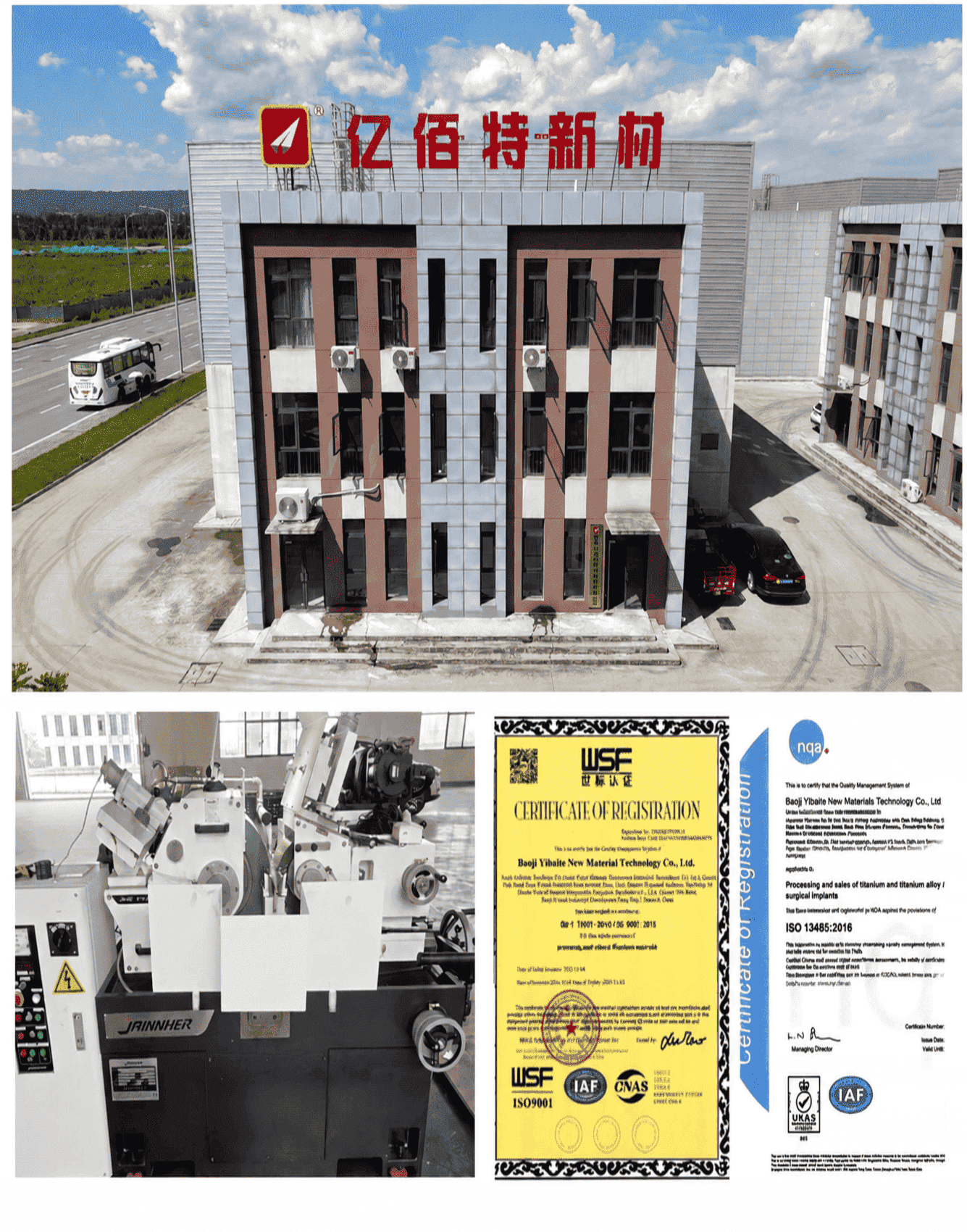
Baoji Yibaite New Materials Technology Co., Ltd. is a high-tech titanium processing company in Baoji, Shaanxi Province - China's Titanium Valley. We supply titanium materials that feed into both traditional and additive manufacturing supply chains:
| Product | Role in the Supply Chain |
|---|---|
| Titanium bars and rods | Starting stock for wire drawing, forging blanks, machined components |
| Titanium wires - precision-drawn | Welding, AM wire-feeding systems, and emerging DED applications |
| Titanium plates and sheets | Structural panels, formed components, traditional aerospace parts |
| Titanium strips | Precision-formed components for consumer electronics and industrial use |