


Samsung's Flex Titanium technology proves that the "space metal" can be as thin as a third of a human hair - and still outperform everything around it.

The Shift
In July 2026, Samsung unveiled Flex Titanium - a technology that eliminates the visible crease in foldable phone screens. The breakthrough is not software or display chemistry. It is titanium alloy, engineered to microscale precision.
This marks a fundamental evolution in how titanium is used. For decades, the metal's value was measured in brute strength - surviving jet engines, submarine pressure hulls, deep-ocean dives. Now, it is being measured by something entirely different: how gracefully it folds in your hand.
The core challenge of any foldable screen is a paradox: the display must be soft enough to bend and stiff enough not to crease.
Samsung's solution uses two titanium components working together:
1. Titanium alloy thin film (support layer)
Positioned beneath the OLED panel, this film is approximately one-third the thickness of a human hair. Through precision rolling, it achieves 20× the mechanical stiffness of polymer films at the same thickness - suppressing crease formation at the source.
2. Titanium metal plate (base layer)
Engineered with advanced micro-perforation to eliminate air gaps, it bonds to the display module with zero clearance. When open: rigid support. When folded: flexible compliance.
This layered "rigid-flexible" design lets titanium do something it has never done before - bend repeatedly without losing its structural identity.

Two Tracks: Heavy Engineering and Precision Electronics

Titanium's application landscape is now clearly splitting into two directions:
| Track | Application | What Titanium Delivers |
|---|---|---|
| Heavy engineering (traditional) | Aerospace, marine, defense | Ultimate strength, corrosion resistance, extreme-condition survival |
| Precision consumer electronics (emerging) | Foldable phones, smartwatches, premium laptops | High specific strength, elastic modulus matching, micron-level processing for thinness and tactile quality |
Both tracks rely on the same material. The difference is in how precisely it is processed.
Three Lessons for the Titanium Industry
Samsung's Flex Titanium reveals broader shifts:
From "weight saving" to "shape enabling."
In consumer electronics, titanium's value is no longer measured in grams saved - it is measured in mechanical structures that no other material can achieve at that thickness.
From military monopoly to mass-market adoption.
As precision rolling and micro-perforation costs decline, titanium is rapidly entering high-volume consumer products - not as a premium exception, but as a standard engineering material.
From single material to integrated system.
Future competition is not about titanium alloy formulations alone. It is about designing complete mechanical systems - where thin film, substrate, adhesive, and display function as one engineered unit.

What This Means for Titanium Demand
Every foldable phone, every titanium-bodied smartwatch, every premium laptop chassis consumes titanium - in forms that did not exist five years ago:
- Ultra-thin precision-rolled sheet
- Micro-perforated titanium plate
- Fine titanium wire for hinges and structural clips
- High-purity titanium strip for electronic shielding
The consumer electronics titanium market is small today compared to aerospace - but it is growing fast, and it demands a level of dimensional precision and surface quality that pushes titanium processing to its limits.
From Foldable Screens to Your Supply Chain: The Same Material Foundation
Whether the application is a foldable phone screen, a jet engine compressor blade, a chemical plant heat exchanger, or a medical implant - the starting point is always the same: carefully processed titanium raw material, produced to exact specifications for chemistry, dimensional accuracy, and surface quality.
The difference between a consumer electronics titanium film and an aerospace titanium forging is not the material - it is the processing precision. But both begin with quality titanium plates, bars, strip, or wire from a reliable source.
We Are Baoji Yibaite New Materials Technology Co., Ltd.
Located in Baoji, Shaanxi Province - China's Titanium Valley, we are a high-tech titanium processing company serving industries from aerospace to consumer products.
What we supply:
- Titanium plates and sheets - for structural, industrial, and formed components
- Titanium bars and rods - for machining, forging, and precision parts
- Titanium wires - for welding, springs, and specialty applications
- Titanium tubes - for heat exchangers, piping, and marine systems
- Titanium strips - for precision-formed components
- Forgings and high-precision products - for aerospace, energy, and demanding industrial use
Grades:
Gr1, Gr2, Gr5 (Ti-6Al-4V), TC4, TA15, and custom specifications.
All products ship with full mill test certificates - from ingot to finished product.
Whether you are developing a consumer electronics product, sourcing material for industrial manufacturing, or evaluating titanium for a new application - we are ready to discuss your requirements.
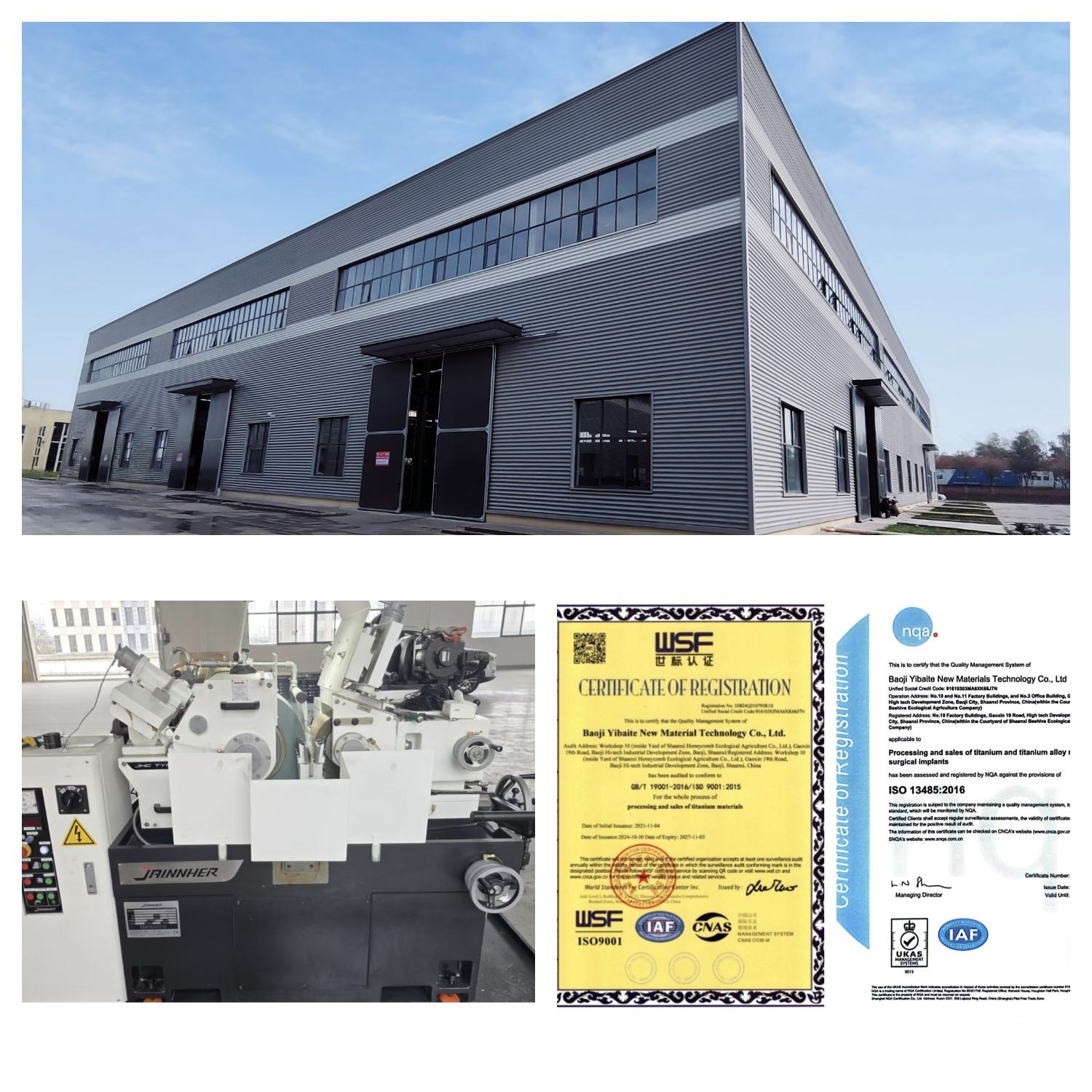
Baoji Yibaite New Materials Technology Co., Ltd. China's Titanium Valley - Your Trusted Titanium Partner.