


INTRO
Fasteners - bolts, screws, rivets, nuts - are easy to overlook. They are small, standardized, and seemingly simple. But in aerospace, marine, energy, and high-performance industrial applications, the material a fastener is made from can determine whether a structure survives or fails.
Here is how titanium alloy fasteners compare to steel across eight critical dimensions.
1. Half the Weight
Titanium's density is approximately 4.5 g/cm³ - roughly 56% that of steel. In applications where thousands of fasteners are used per assembly (aircraft, spacecraft, racing vehicles), the cumulative weight savings are substantial.

2. Higher Specific Strength - Smaller Fasteners
Titanium's strength-to-weight ratio exceeds steel. For the same load requirement, a titanium fastener can have a smaller cross-section - saving space in tight assemblies. Titanium can even replace aluminum fasteners at a smaller size, which is critical in aerospace where every millimeter matters.

3. Superior Heat Resistance
Titanium's melting point (~1,668°C) and its resistance to softening and creep at elevated temperatures make titanium fasteners the standard choice for engine-adjacent and hot-section connections where steel fasteners would degrade.

4. Better Thermal Fatigue Life
Titanium has a lower coefficient of thermal expansion and lower elastic modulus than steel. Under repeated temperature cycling, titanium fasteners generate less thermal stress - reducing the risk of loosening, cracking, or fatigue failure over time.

5. Permanently Non-Magnetic
| Material | Magnetic Behavior |
|---|---|
| Carbon steel | Magnetic |
| Stainless steel (austenitic) | Initially non-magnetic, but cold working (e.g., thread rolling) induces martensitic transformation - becomes magnetic |
| Titanium alloy | Non-magnetic regardless of processing - hot or cold worked, always zero magnetic permeability |
This makes titanium fasteners essential around avionics, MRI equipment, precision instruments, and any environment where magnetic interference is unacceptable.

6. Higher Yield-to-Tensile Strength Ratio
In bolted joints, yield strength matters more than ultimate tensile strength - once a fastener yields (permanently deforms), it loses clamping force even if it has not fractured.
Titanium's yield strength is very close to its tensile strength - higher yield ratio than most steels. This means titanium fasteners are more resistant to permanent deformation under overload, providing greater joint reliability.

7. Electrochemically Compatible with Carbon Fiber
This is one of the biggest drivers of titanium fastener adoption in modern aerospace:
- Steel fasteners on carbon fiber reinforced polymer (CFRP): Large galvanic potential difference → severe galvanic corrosion at the interface
- Titanium fasteners on CFRP: Electrode potential is closely matched → minimal galvanic corrosion
As aircraft structures increasingly use CFRP composites, titanium fasteners are not optional - they are mandatory.

8. Excellent Corrosion and Creep Resistance
Titanium resists seawater, acid, alkali, and chloride environments - maintaining fastener integrity where steel would corrode and weaken. Its creep resistance at elevated temperatures further extends service life in demanding conditions.

Summary Comparison
| Property | Steel | Titanium |
|---|---|---|
| Density | ~7.9 g/cm³ | ~4.5 g/cm³ |
| Specific strength | Moderate | Excellent |
| Heat resistance | Good | Superior |
| Thermal fatigue life | Moderate | Better |
| Magnetic behavior | Magnetic (or becomes magnetic after cold work) | Permanently non-magnetic |
| Yield ratio | Lower | Higher - more resistant to permanent deformation |
| CFRP compatibility | Causes galvanic corrosion | Electrochemically matched - no galvanic corrosion |
| Corrosion resistance | Requires coatings in harsh environments | Inherently corrosion-proof |
The Trade-Off
Titanium fasteners cost more than steel - typically 3–10× per unit depending on grade and specification. But in applications where weight, reliability, corrosion resistance, magnetic neutrality, or composite compatibility are critical, the total system value far outweighs the per-unit cost difference.
The Material Behind Every Fastener
A titanium fastener is only as reliable as the titanium it is made from. Chemistry, microstructure, and dimensional consistency all determine whether a fastener performs as specified - or becomes a failure point.
Baoji Yibaite New Materials Technology Co., Ltd. is a high-tech titanium processing company in Baoji, Shaanxi Province - China's Titanium Valley. We supply the titanium raw materials used in fastener manufacturing:
What we supply:
- Titanium plates and sheets - for structural, industrial, and formed components
- Titanium bars and rods - for machining, forging, and precision parts
- Titanium wires - for welding, springs, and specialty applications
- Titanium tubes - for heat exchangers, piping, and marine systems
- Titanium strips - for precision-formed components
- Forgings and high-precision products - for aerospace, energy, and demanding industrial use
Grades:
Gr1, Gr2 (preferred for consumer and food-contact products - nickel-free, biocompatible), Gr5 (Ti-6Al-4V - for high-strength applications), and custom specifications.
All products ship with full mill test certificates - because the material behind a premium product must itself be premium
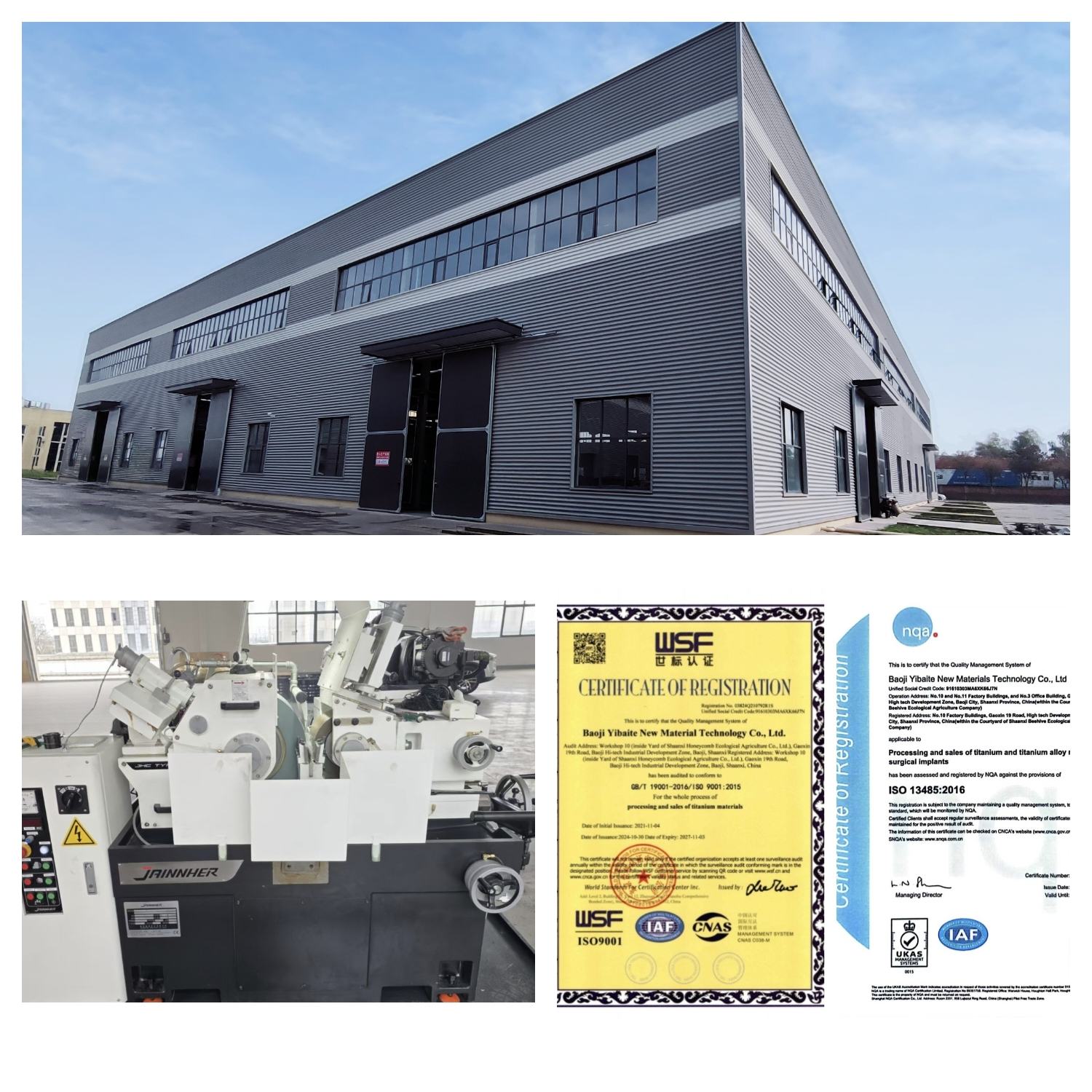
Baoji Yibaite New Materials Technology Co., Ltd. China's Titanium Valley - Your Trusted Titanium Partner.