


Xiaomi just filed a comprehensive patent covering titanium alloy powder, additive manufacturing processes, and vehicle applications. This signals something bigger than one company's R&D - it marks titanium's serious entry into automotive mass production.
What Xiaomi Patented
Xiaomi Auto and Anhui Zhongti New Materials have jointly filed a patent that covers the entire value chain of automotive titanium additive manufacturing: custom powder formulation, printing process optimization, finished component specifications, and vehicle-level integration.
The core innovation is a custom titanium alloy powder - titanium-based, with precisely controlled aluminum and vanadium content, plus a novel micro-addition of nitrogen to optimize the as-printed microstructure. The result:
- Improved strength, toughness, corrosion resistance, and fatigue life across all key mechanical metrics
- Reduced defect rates during printing - the powder formulation is specifically optimized for additive manufacturing processability
- Production-scale economics - breaking the cost barrier that has long kept high-performance titanium out of automotive applications

Why This Matters for the Auto Industry
Traditional manufacturing has three pain points
| Problem | Traditional Route (Forging/Casting) |
|---|---|
| Process complexity | Multiple steps - molds, dies, heat treatment, machining |
| Material waste | Forging utilization as low as 20–30% |
| Complex geometry | Difficult or impossible without multi-part assembly |
Additive manufacturing eliminates all three
3D printing builds titanium components layer by layer from powder - no molds, minimal waste, and the ability to produce complex, lightweight, integrated structures in a single build. Development-to-production timelines compress dramatically.
Where 3D-printed titanium goes on a car
| Component Area | Benefit of Titanium |
|---|---|
| Body structural components | Weight reduction at equivalent crash strength |
| Brake system components | Heat resistance, reduced unsprung mass |
| Suspension parts | High specific strength, fatigue resistance |
| Premium interior precision components | Aesthetic quality, lightweight, corrosion-proof |
For electric vehicles, every kilogram saved translates directly to extended range, improved handling, and better braking performance - aligning perfectly with the industry's core lightweighting objective.
The Bigger Picture: Xiaomi's Strategic Intent
This patent reflects a deliberate move into upstream supply chain control. In China's new energy vehicle industry, competition has expanded beyond vehicle assembly and software intelligence into materials science and core manufacturing processes.
Until now, most high-performance titanium automotive technology was held by overseas companies. Xiaomi's patent represents domestic self-sufficiency in both material formulation and manufacturing process - building a proprietary technology moat for future premium vehicle models.
Industry observers note that materials innovation is becoming the primary performance differentiator in next-generation EVs. Xiaomi's entry into titanium additive manufacturing not only strengthens its own product capabilities but also accelerates the broader adoption of advanced titanium materials across China's automotive sector.
![U-EV]預售價81.49萬人民幣,量產版小米Xiaomi SU7 Ultra正式亮相,原型車成紐北最速四門車| U-CAR新聞](https://image.u-car.com.tw/articlethumb_97_80805.jpg?size=x0 "U-EV]預售價81.49萬人民幣,量產版小米Xiaomi SU7 Ultra正式亮相,原型車成紐北最速四門車| U-CAR新聞")
What This Means for Titanium Demand
The automotive industry consumes approximately 80 million vehicles per year globally. Even modest titanium adoption - starting with premium and performance models - creates enormous material demand:
| Scenario | Implication |
|---|---|
| Titanium adoption in high-end EVs only | Thousands of tons of new titanium powder and feedstock demand annually |
| 3D printing replaces traditional forging for select parts | Shift from bar/billet to powder feedstock - new supply chain requirements |
| Cost reductions enable broader deployment | Mid-range vehicles adopt titanium - demand multiplier effect |
The global titanium additive manufacturing market is still early-stage in automotive, but patents like Xiaomi's indicate that the technology and economics are reaching the tipping point for commercial adoption.
From Automotive Titanium to Raw Material: Our Role
Whether a titanium automotive component is forged from bar, stamped from sheet, or 3D-printed from powder, the starting point is always the same: carefully processed titanium raw material.
For additive manufacturing, the supply chain runs: titanium ingot → bar/billet → gas/plasma atomization → spherical powder → printing. The chemistry, cleanliness, and consistency of the starting ingot and bar determine the quality of the powder - and therefore the reliability of every printed automotive part.
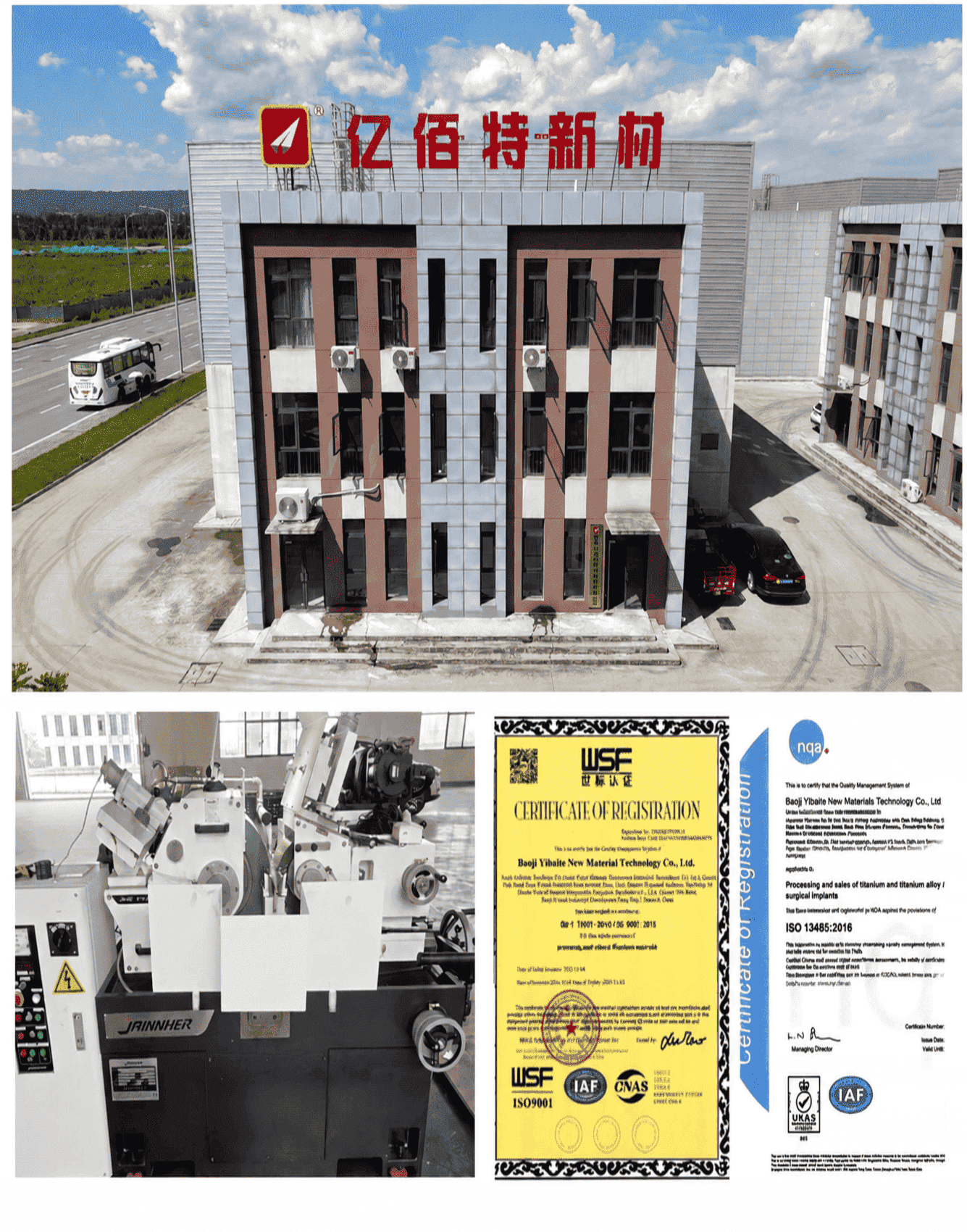
Baoji Yibaite New Materials Technology Co., Ltd. is a high-tech titanium processing company in Baoji, Shaanxi Province - China's Titanium Valley. We supply titanium materials that feed into both traditional and additive manufacturing supply chains for automotive, aerospace, medical, and industrial applications:
| Product | Automotive Application |
|---|---|
| Titanium bars and rods | Forging stock, machined components, powder production feedstock |
| Titanium plates and sheets | Stamped structural panels, brake components, formed parts |
| Titanium wires | Welding, AM wire-feeding systems, fasteners, springs |
| Titanium strips | Precision-formed components, decorative elements |
Grades available:
- Grade 2 - for corrosion-critical and general structural applications
- Grade 5 (Ti-6Al-4V) - the standard for high-strength automotive and aerospace components
- Grade 9 (Ti-3Al-2.5V) - for cold-formed and welded tubular products
- Grade 23 (Ti-6Al-4V ELI) - for medical and high-toughness applications
- Custom specifications upon request
All products ship with full mill test certificates - from ingot to delivered product.
Conclusion
Xiaomi's titanium additive manufacturing patent is not just a corporate R&D milestone. It is a signal that titanium is crossing the threshold from aerospace exclusivity to automotive mass-market adoption in China - the world's largest EV market.
As this technology matures and scales, demand for high-quality titanium raw material - bar for powder production, plate for traditional components, wire for AM systems - will grow significantly. The companies that control material quality from the beginning of the supply chain will be the ones that enable this transformation.
That is what we do, every day, from China's Titanium Valley.