


When a bomb disposal robot extends its mechanical arm toward an unknown explosive, the operator's safety depends on one thing: the structural integrity of the robot's frame. Adding more steel made robots heavier and less capable. Titanium alloy changed the equation entirely.
The Old Logic: Heavier Meant Safer - Until It Didn't
For years, the explosion-proof robot industry followed a simple formula: thicker steel plates equal better blast resistance. The result was predictable - tracked robots exceeding 300 kg, struggling to navigate narrow corridors, staircases, and rubble fields. The machines designed to protect human life could not reach the locations where they were needed most.
The weight created a cascade of problems:
- Poor maneuverability - unable to turn in confined spaces
- Limited obstacle capability - stalling on 40-degree slopes and 300mm barriers
- High center of gravity - prone to tipping on stairs and across ditches
- Inaccessible deployment sites - too heavy for standard elevators, too bulky for subway tunnels and high-rise buildings
The industry needed a material that was both strong enough to survive blast impacts and light enough to navigate real-world deployment environments. Titanium alloy was the answer.
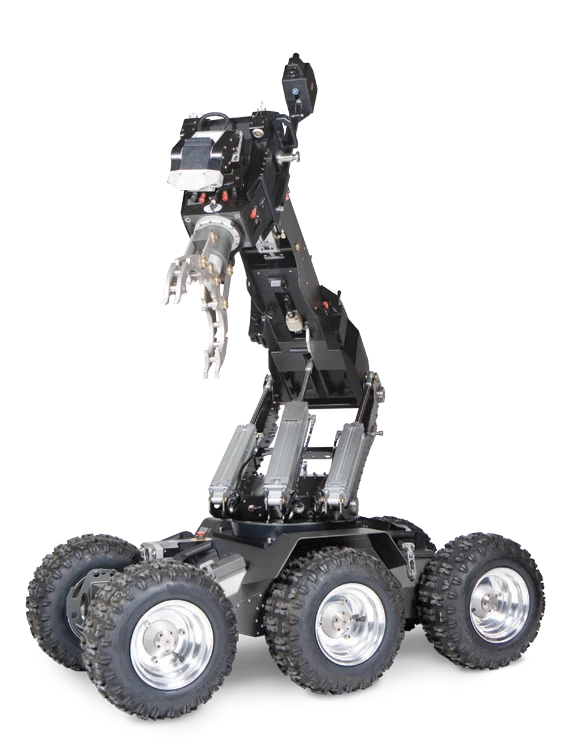
The Breakthrough: 45% Lighter, Same Blast Resistance
Titanium alloy structural frames - specifically Grade 5 (Ti-6Al-4V) forgings produced through single-piece forging processes - deliver equivalent blast resistance at dramatically lower weight.
| Metric | Steel Frame | Titanium Frame |
|---|---|---|
| Core structural weight | Baseline | 45%+ reduction |
| Total robot weight (medium class) | 300+ kg | Under 160 kg |
| Turning agility | Baseline | 30% improvement |
| Standard elevator compatible | No | Yes |
| Operational radius in confined spaces | Limited | Doubled |
A 160 kg titanium-framed robot fits in a standard passenger elevator, navigates subway tunnels, climbs stairs, and operates in high-rise buildings - environments where its 300 kg steel predecessor simply could not go.
Surviving the Blast: What Happens to the Frame
The robot's core mission is to protect its internal electronics - controllers, sensors, communication modules, cameras - through a blast event. If the frame deforms under shockwave loading and crushes these components, the robot is disabled. Worse: the unexploded device it was sent to neutralize is now uncontrolled.
Deformation control under blast loading
Testing by leading Chinese explosion-proof robot manufacturers shows that topology-optimized titanium alloy frames maintain structural deformation within 0.2 mm after a 1 kg TNT-equivalent close-range detonation. Internal CCD cameras, multi-axis manipulator control units, and communication systems survived intact. The robot continued executing its disposal mission after the blast.
Why titanium survives where steel fails
| Property | Structural Steel | Grade 5 Titanium (Ti-6Al-4V) |
|---|---|---|
| Tensile strength | ~400–550 MPa | 900+ MPa |
| Specific strength (strength ÷ density) | Baseline | 1.5× higher |
| Behavior under instant shock | Risk of brittle fracture | Superior dynamic impact toughness - resists brittle failure |
| Weld joint integrity after repeated impacts | Micro-cracks develop at welds - difficult to detect, sudden failure risk | Friction stir weld joints approach parent material strength - no visible cracking after 1 million vibration cycles |
| Post-blast service life | Limited | 2× longer un-faulted service life |
The critical difference: traditional steel frames develop invisible micro-cracks at weld joints after repeated vibration and blast loading. These cracks are nearly impossible to detect during maintenance - and fail suddenly during the next mission. Titanium frames, produced through single-piece forging with localized friction stir welding, eliminate this failure mode. The weld - traditionally the weakest point - becomes the strongest link in the structural chain.
Weight reduction does not just improve survivability - it transforms what the robot can do:
| Capability | Impact of Titanium Weight Reduction |
|---|---|
| Access | Fits in standard elevators, navigates subway tunnels, climbs stairs - locations previously unreachable |
| Payload | Freed weight budget allows mounting additional specialized equipment - sensors, tools, countermeasures |
| Speed | Lighter robot accelerates faster, responds quicker to time-critical situations |
| Stability | Lower center of gravity reduces tipping risk on slopes, stairs, and uneven terrain |
Extending to industrial hazardous inspection
The same titanium structural logic applies to industrial explosion-proof quadruped robots operating in petrochemical plants, refineries, and other flammable/explosive environments. One leading Chinese manufacturer uses a multi-material approach - titanium alloy for core load-bearing joints and high-frequency moving parts, supplemented by 7-series aluminum and specialty steel for secondary structures.
Titanium's contribution to these platforms goes beyond strength and weight:
- Low static electricity generation - titanium's surface properties reduce friction-induced electrostatic discharge risk, eliminating a potential ignition source in explosive atmospheres
- Low surface temperature rise - titanium dissipates heat differently than steel, reducing hot-spot ignition risk
- Fatigue resistance - critical for joints and legs that undergo millions of repetitive motion cycles
This platform won the 2024 US IDEA Design Award - the first quadruped robot to receive this recognition globally - validating the titanium multi-material architecture approach.
High-latitude and extreme cold applications
Some manufacturers are now using Grade 23 (Ti-6Al-4V ELI) - extra-low interstitials titanium alloy - for explosion-proof robot frames operating in extreme cold environments. Grade 23's superior low-temperature toughness ensures reliable blast resistance in sub-zero conditions where standard steel becomes brittle and fracture-prone.

The Material Properties That Make It Work
| Property | Value (Grade 5 / Ti-6Al-4V) | Why It Matters for Explosion-Proof Robots |
|---|---|---|
| Density | ~4.43 g/cm³ (56% of steel) | Lighter robot - better access and maneuverability |
| Tensile strength | 900+ MPa | Resists blast deformation in minimal cross-section |
| Specific strength | 1.5× structural steel | More protection per kilogram |
| Fatigue resistance | Excellent | Survives millions of vibration cycles without cracking |
| Corrosion resistance | Immune | No rust in outdoor, underground, or chemical environments |
| Weldability (friction stir) | Excellent - weld approaches parent strength | Eliminates the weak point that fails in steel frames |
Every titanium robot component - whether a single-piece forged main frame, a machined joint, or a formed cover panel - begins as carefully processed titanium raw material. Billet for forging. Bar for machining. Plate for formed panels. Wire for welding consumables.
The blast resistance and fatigue life that protect a robot's internal systems - and the operator standing safely behind it - all depend on material quality. Chemistry consistency, microstructure uniformity, freedom from inclusions, and precise mechanical property verification are non-negotiable for safety-critical structural applications.
Baoji Yibaite New Materials Technology Co., Ltd. is a high-tech titanium processing company in Baoji, Shaanxi Province - China's Titanium Valley. We supply titanium materials used in robotics, defense, aerospace, marine, and industrial applications:
| Product | Robotics / Defense Application |
|---|---|
| Titanium bars and rods | Forging stock for main frames, machined joints, structural nodes, fasteners |
| Titanium plates and sheets | Formed covers, structural panels, enclosure components |
| Titanium wires | Welding consumables for frame fabrication and repair |
| Forgings | High-integrity structural components - frames, joints, load-bearing nodes |
All products ship with full mill test certificates - chemistry, mechanical properties, dimensions - traceable from ingot to delivered product.
