2026: The Year Mass Production Begins
Two events in July 2026 made the signal unmistakable.
In Shanghai, the World AI Conference opened with over 100,000 m² of exhibition space, 1,100+ companies, and multiple humanoid robot global premieres. China's Ministry of Industry disclosed that full-year humanoid robot production is projected to exceed 100,000 units - up from approximately 12,000 in 2025.
In the United States, Tesla issued procurement guidance to suppliers demanding Optimus Gen 3 weekly production of 1,000 units by September and 2,000–2,500 per week by year-end. Tesla dismantled its Model S and Model X production lines in just 46 days to make space.
Both events point to the same conclusion: 2026 is the year humanoid robots go from prototype to product. And titanium alloy is becoming their structural material of choice.
Why Humanoid Robots Need Titanium
A typical humanoid robot contains 14–16 actuated joints that determine motion precision, flexibility, and load capacity. These joints - along with the spine, sensor housings, and structural frame - demand a material that is simultaneously lightweight, strong, fatigue-resistant, and reliable across environments.
Titanium alloy delivers all four.
Lightweight: faster movement, longer operation
Titanium's density is approximately 56% that of steel with comparable strength. In Tesla's Optimus Gen 3, hip and knee joint gear sets made from Grade 5 (Ti-6Al-4V) with 3D-printed hollow structures achieve:
- 40% weight reduction per joint assembly
- 3× fatigue life improvement over stainless steel equivalents
Industry data indicates a single humanoid robot uses approximately 3–5 kg of titanium alloy, concentrated in biomimetic joint gear sets, spinal support frames, and sensor enclosures. Optimus Gen 3 reportedly increased titanium usage from 1.2 kg (Gen 2) to 4.5 kg, raising titanium's share of material cost from 7% to 19%.
High strength: reliable under load
Boston Dynamics' Atlas V11 uses a lattice-structured titanium alloy spinal frame that maintains 25 kg payload capacity while increasing overall rigidity by 18%. Harbin Institute of Technology developed gradient-porosity titanium alloy with 32% improved energy absorption - now in prototype validation for intelligent robots.
Fatigue resistance: built for repetitive motion
Robots perform thousands of motion cycles daily. Titanium's fatigue resistance - already proven in medical implants through 2 million cycle testing on UBTECH's Walker X platform - ensures reliable long-term operation. Titanium alloy maintains stable performance from -40°C to 120°C, across factory dust, acid-alkali environments, outdoor rain, snow, and humidity.

The Market Is Exploding
Policy acceleration
China's 2024 Guiding Opinions on Humanoid Robot Innovation and Development formally designated "titanium alloy precision forming technology" as one of ten national priority engineering projects. Multiple provincial governments have established dedicated funds supporting titanium 3D printing and related manufacturing processes for robotics.
Demand data
| Metric | Value |
|---|---|
| Q1 2025 robot titanium alloy orders (China) | +217% year-over-year |
| Monthly production capacity | 80+ tons - 3× the 2023 level |
| 2026 humanoid robot shipment forecast (Morgan Stanley) | ~50,000 units |
| 2026 forecast (GGII Research) | 62,500 units |
| Global humanoid robot titanium market (2024) | ~$180 million |
| Global humanoid robot titanium market (2030 projected) | ~$2.6 billion |
| Compound annual growth rate | 49.3% |
From 180 million to 2.6 billion in six years - a new billion-dollar titanium application sector is forming.
Three "Battle Stations" for Titanium in Humanoid Robots
Joint gear sets - the movement core
Each robot joint contains precision gears, bearings, and linkages that must be lightweight yet capable of handling repeated high-torque loads. Titanium alloy - especially Grade 5 (Ti-6Al-4V) - provides the specific strength and fatigue resistance needed. 3D-printed hollow gear structures further reduce mass while maintaining structural integrity.
Spinal support frames - the structural backbone
The robot's spine must support the entire upper body while allowing multi-axis flexibility. Titanium lattice and mesh-frame designs deliver high rigidity at minimal weight - the same engineering logic used in aerospace structural optimization.
Sensor enclosures and precision housings
Position sensors, force sensors, and environmental sensors require housings that are dimensionally stable, non-magnetic, corrosion-resistant, and lightweight. Titanium meets all requirements - and its non-magnetic properties ensure zero interference with sensor electronics.

The Manufacturing Revolution: 3D Printing Meets Titanium
Additive manufacturing is the enabling technology that makes titanium robotics components economically viable:
| Advantage | Impact |
|---|---|
| Complex hollow structures | Weight reduction up to 60% - impossible with traditional machining |
| Biomimetic lattice designs | Mimics bone trabeculae - optimized strength-to-weight at every point |
| No tooling required | Rapid design iteration - days instead of weeks |
| Material efficiency | 95%+ utilization vs. 20–30% for traditional forging |
At the 2026 Formnext Shenzhen exhibition, titanium-focused 3D printing solutions for robotics were a major highlight - signaling that the manufacturing infrastructure is catching up to the demand signal.
Every titanium robot component - whether a 3D-printed joint gear, a machined spinal node, or a precision sensor housing - begins as carefully processed titanium raw material.
For additive manufacturing, the supply chain runs: titanium ingot → bar/billet → gas atomization → spherical powder → 3D printing. The quality of the starting ingot and bar determines the chemistry, particle size distribution, and flowability of the powder - and therefore the reliability of every printed robot component.
For traditional machining, the chain runs: titanium ingot → bar/plate → forging → machining → finished part. Again, starting material quality propagates through every subsequent step.
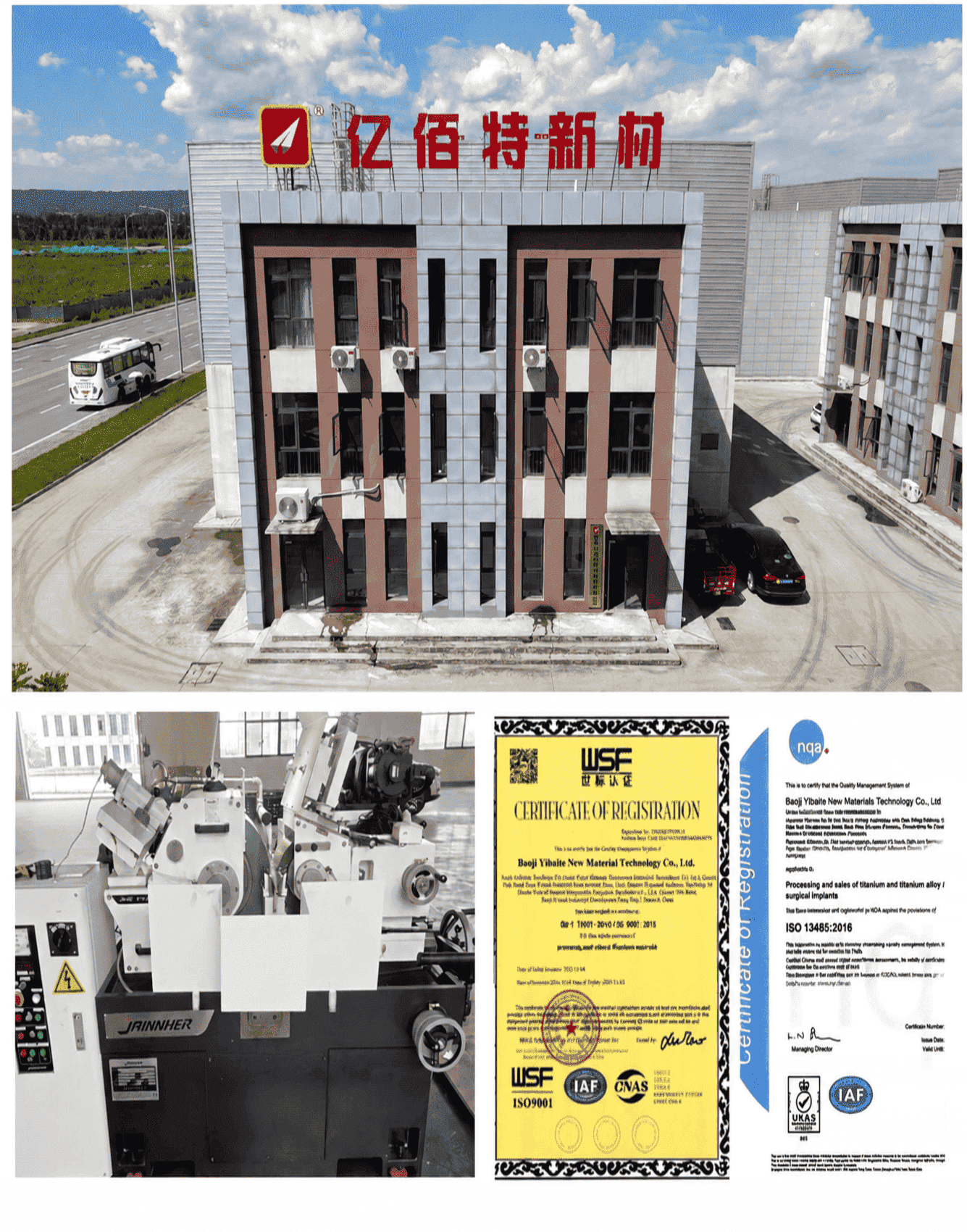
Baoji Yibaite New Materials Technology Co., Ltd. is a high-tech titanium processing company in Baoji, Shaanxi Province - China's Titanium Valley. We supply titanium materials that feed into both traditional and additive manufacturing supply chains for robotics, aerospace, medical, and industrial applications:
| Product | Robotics Application |
|---|---|
| Titanium bars and rods | Machined joint components, gear blanks, shaft housings, powder production feedstock |
| Titanium plates and sheets | Structural frames, sensor housings, formed brackets |
| Titanium wires | Springs, clips, welding consumables for assembly |
| Titanium strips | Precision-formed structural elements |
| Forgings | High-integrity joint and structural components |