


Traditional jewelry relies on gold, silver, and platinum. But the world's most visionary jewelers are turning to a different metal - titanium - to create pieces that are lighter, bolder, and impossible to achieve with any other material.

The Master Who Changed Everything
When discussing titanium jewelry, one name stands above all others: Wallace Chan, the Hong Kong-based master jeweler who pioneered the use of titanium in high jewelry.
His creation "A Dance in the Wind" necklace combines rubies and sapphires with a titanium metal base, achieving a fluid, weightless beauty that would be impossible in gold or platinum. His "Fish's Dream" series fuses titanium with purple and blue sapphires to create ocean-themed visual spectacles - pieces of extraordinary scale and complexity that remain surprisingly light on the body.
Chan chose titanium not for novelty, but for necessity. His designs demanded a material that could hold large gemstone arrangements without the crushing weight that gold or platinum would impose. Titanium delivered exactly that.
Why Titanium Works for Jewelry
| Property | What It Means for Jewelry |
|---|---|
| Ultra-lightweight | ~4.5 g/cm³ - roughly 57% the density of gold, 56% of platinum. Large, dramatic pieces become wearable |
| High melting point | 1,668°C - allows complex fabrication techniques without material failure |
| Corrosion-proof | Never tarnishes, never oxidizes - maintains its finish indefinitely without polishing |
| Hypoallergenic | Biocompatible - safe for sensitive skin, no nickel reactions |
| Anodizable colors | Through anodization, titanium produces vivid permanent colors - sapphire blue, emerald green, rose gold, deep violet - without paint, coating, or dye |
That last point is particularly significant. Gold is yellow. Silver is white. Platinum is grey. But titanium can be any color - achieved through a controlled oxide film that refracts light into the visible spectrum. This gives designers a palette that no precious metal can match.


The Design Freedom No Other Metal Offers
Traditional jewelry faces a fundamental constraint: dramatic scale requires heavy material. A large gold necklace with substantial gemstone settings can weigh hundreds of grams - uncomfortable to wear and limited in structural ambition.
Titanium removes this constraint. A necklace of identical visual scale in titanium weighs a fraction of its gold equivalent, freeing the designer to think bigger, bolder, and more sculpturally - without punishing the wearer.
This is why the world's top haute joaillerie houses are increasingly incorporating titanium into their most ambitious creations:
- Large-scale necklaces and body pieces that would be unwearably heavy in precious metals
- Color-intensive designs using anodized titanium as a visual complement to gemstones
- Structural complexity - intricate openwork and lattice forms enabled by titanium's strength-to-weight ratio
Beyond Luxury: Titanium Jewelry for Everyone
While Wallace Chan operates at the pinnacle of high jewelry, titanium's advantages are increasingly accessible at every price point:
- Wedding rings - lightweight, scratch-resistant, hypoallergenic, and far more affordable than platinum
- Everyday earrings and parrings - comfortable for all-day wear, especially important for those with metal sensitivities
- Men's jewelry - titanium's industrial aesthetic and matte finishes appeal to buyers seeking alternatives to traditional precious metals
- Fashion and statement pieces - anodized colors enable designs that are visually impossible with gold or silver

The Material Behind the Art
Every titanium jewelry piece - from a haute joaillerie masterpiece to an everyday wedding band - begins as carefully processed titanium raw material. The wire, strip, sheet, or bar from which it is fabricated must meet strict standards for purity, surface quality, and dimensional precision, because any flaw in the starting material will appear in the finished piece.
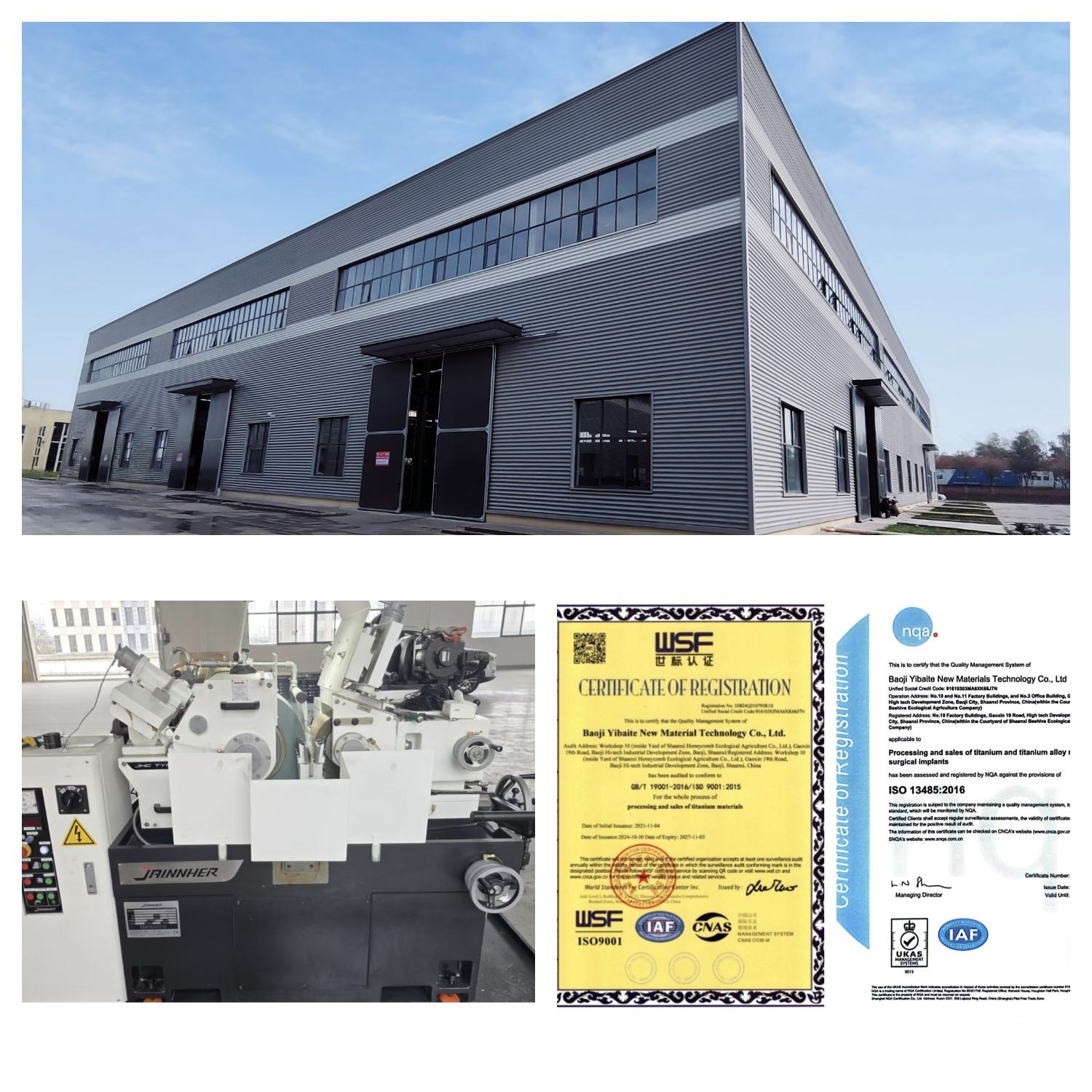
Baoji Yibaite New Materials Technology Co., Ltd. is a high-tech titanium processing company in Baoji, Shaanxi Province - China's Titanium Valley. We supply the titanium raw materials used by jewelry designers, manufacturers, and consumer product brands:
| Product | Jewelry Application |
|---|---|
| Titanium wires | Ring bands, earring posts, chain links, prong settings |
| Titanium strips | Precision-formed band profiles, pendants, decorative elements |
| Titanium plates and sheets | Stamped and laser-cut pendants, cufflinks, brooches |
| Titanium bars and rods | Machined custom components, signet rings, bolt-style jewelry |
Grades available:
- Gr1, Gr2 (commercially pure titanium) - the standard for jewelry - maximum biocompatibility, optimal anodization response, excellent formability
- Custom specifications upon request
All products ship with full mill test certificates - because the material behind a beautiful piece must itself be pure and consistent.
The Takeaway
Titanium has earned its place in aerospace, medicine, marine engineering, and cookware. Now it is earning its place in jewelry - not as a substitute for gold, but as a material that enables entirely new possibilities: lighter, stronger, more colorful, and kinder to skin.
From Wallace Chan's museum-grade masterpieces to a simple hypoallergenic wedding band, titanium is redefining what jewelry can be. And it all starts with quality raw material.
Baoji Yibaite New Materials Technology Co., Ltd. China's Titanium Valley - Your Trusted Titanium Partner.